Strategic Foresight & Scenario Planning Process
Build a strategy that survives more than one future
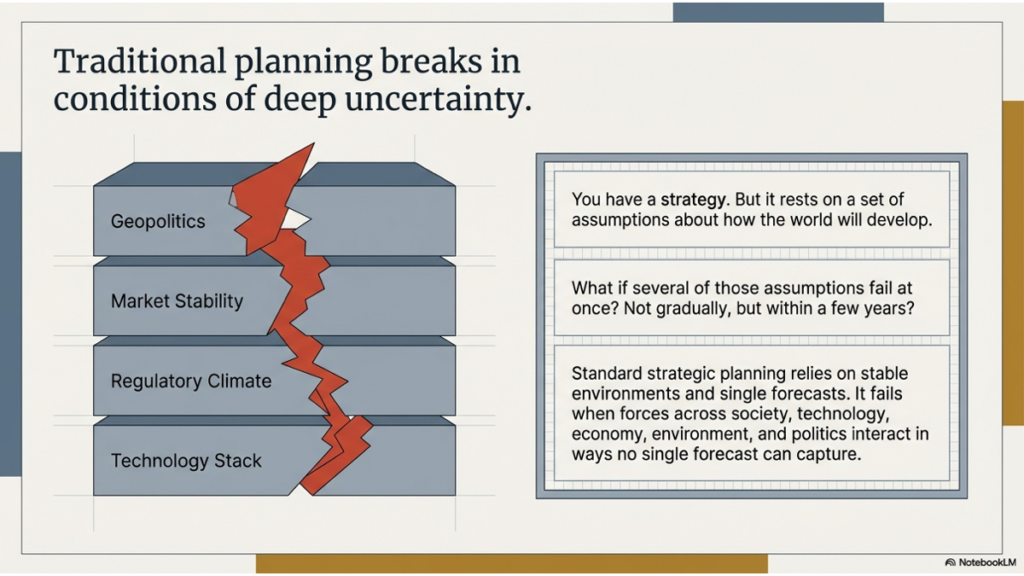
You have a strategy. But it rests on a set of assumptions about how the world will develop — your market, your regulators, your customers, your technology stack. What if several of those assumptions fail at once? Not gradually, but within a few years?
Traditional strategic planning works well in stable environments. It breaks in conditions of deep uncertainty — where the forces shaping your sector (technology, geopolitics, demographics, climate, regulation) interact in ways no single forecast can capture.
This service is for organisations that need a rigorous, end-to-end foresight process — designed from scratch around a specific strategic challenge, not delivered from a template.
Strategic Foresight – What It Is
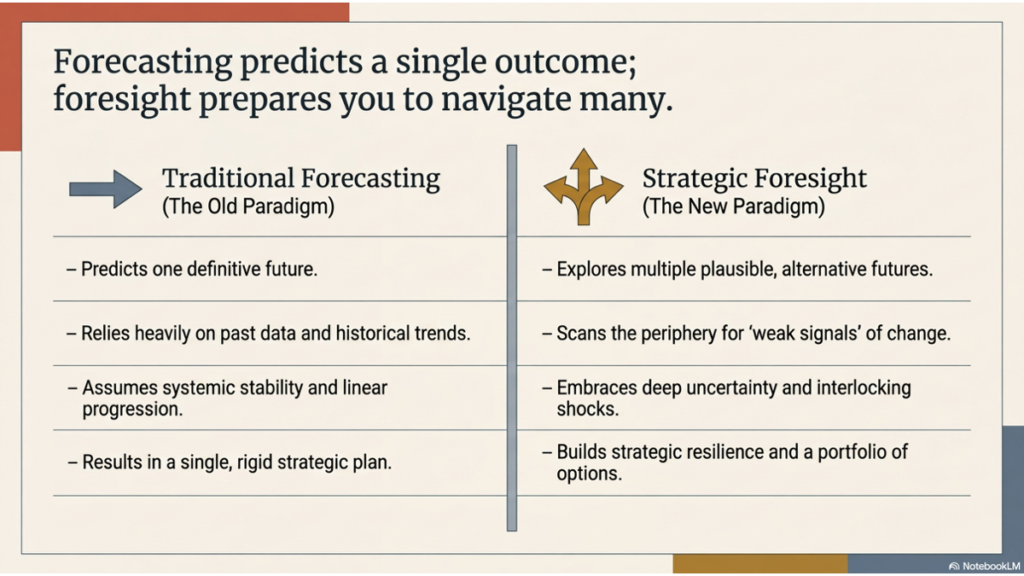
Strategic foresight is the disciplined practice of exploring, anticipating, and preparing for multiple possible and plausible futures to make better decisions today.
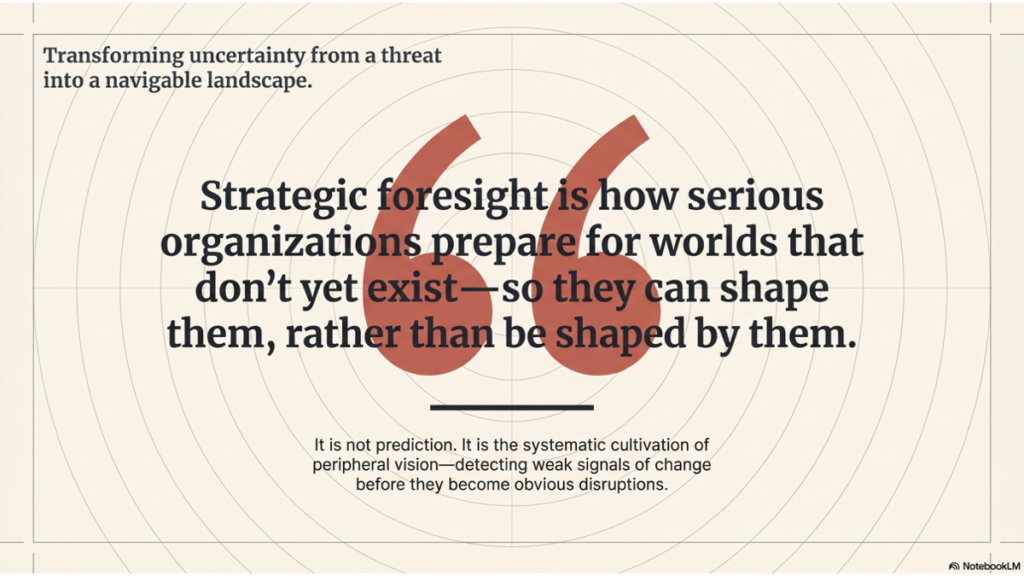
It is not prediction. It is not forecasting. It is the systematic cultivation of organizational peripheral vision – the capacity to detect weak signals of change before they become obvious disruptions, and to translate that awareness into strategic advantage.
Foresight combines rigorous analysis with structured imagination: scanning the horizon for emerging forces, challenging inherited assumptions, and stress-testing strategies against futures that may unfold very differently from the present. It transforms uncertainty from a threat into a navigable landscape.
Strategic Foresight – How It Works
The foresight process begins with listening – to the periphery, to anomalies, to the changes your competitors haven’t noticed yet. We scan across domains: technology, society, economy, environment, politics, and values. We identify the driving forces shaping your operating context and the weak signals that hint at what’s next.
From there, we move to sense-making. We cluster trends, trace interconnections, and surface the critical uncertainties that will define your strategic choices. Not everything matters equally – foresight separates signal from noise.
Then comes the work that distinguishes foresight from ordinary planning: scenario building. We construct multiple plausible futures – not best-case or worst-case fantasies, but rigorously developed alternative worlds your organization might actually face. Each scenario is a thinking tool, a stress-test, a rehearsal space.
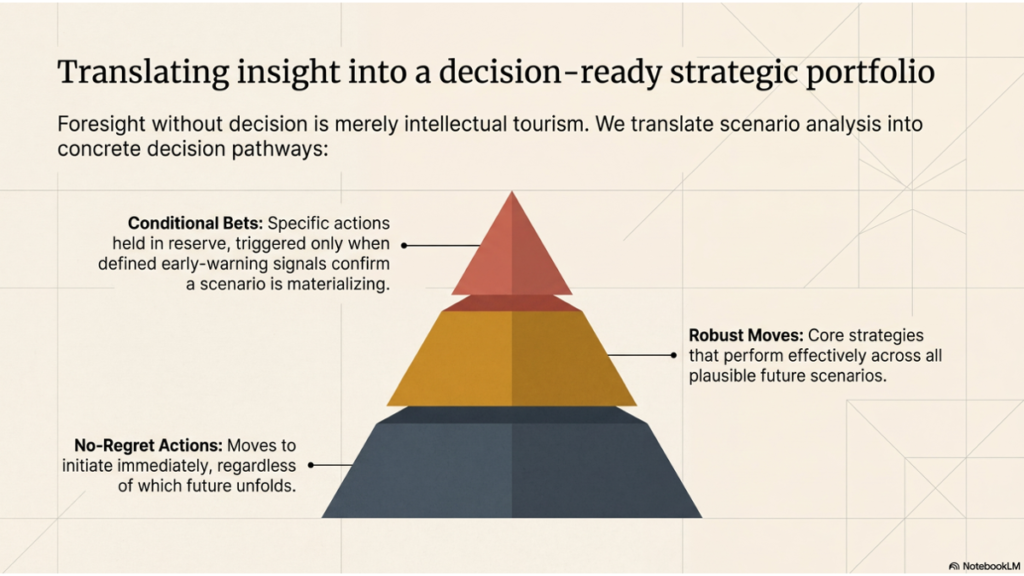
Finally, we turn insight into action. We identify robust strategies that perform well across scenarios, early warning indicators to monitor, and strategic options to develop now – before they become urgent. Foresight without decision is merely intellectual tourism.
We ensure it lands.
Strategic Foresight – Why It Matters
For those who lead organizations in uncertain times: You already know the future won’t resemble the past. The question is whether you’ll meet it prepared or surprised.
Foresight delivers strategic resilience – the capacity to absorb shocks and adapt faster than your environment changes.
It provides competitive anticipation – seeing opportunities and threats while others are still reacting.
It builds decision confidence – the clarity to commit resources when the path forward is genuinely unclear.
More than this: foresight changes how your organization thinks. It breaks the tyranny of the present tense. It expands the range of options your team can imagine. It creates shared language for discussing the uncertain. It makes your strategy conversations smarter.
Every organization will face futures it did not expect. The difference is whether you’ve rehearsed them.
What you get
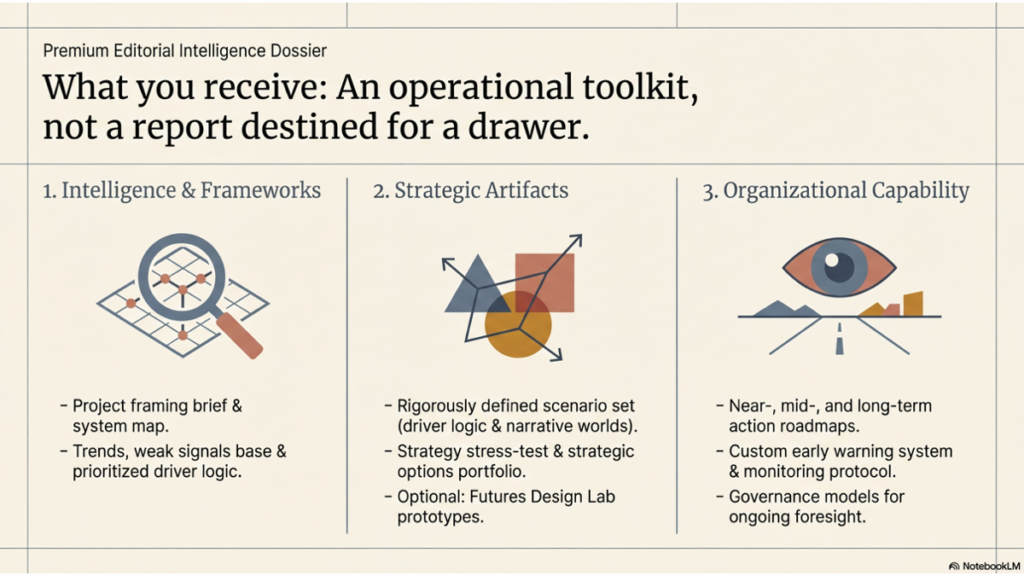
A map of the forces reshaping your world
We identify the megatrends, macrotrends, emerging trends, microtrends, emerging cases, weak signals, convergences, disruptions, and critical uncertainties most relevant to your sector and decision horizon. This is not a generic trends report — it’s an intelligence map built specifically for your strategic context, with weak signals and “quiet disruptions” that standard analysis misses.
A set of scenarios you can actually use
Internally consistent, rigorously constructed visions of how your operating environment might evolve over 5–30 years. Each scenario is designed to challenge a different set of assumptions your organisation currently holds – and to stress-test your strategy against worlds you haven’t planned for.
Strategic options, not just insight
We translate scenario analysis into concrete decision pathways: robust moves that work across futures, conditional bets to place when specific signals confirm, and “no-regret” actions to start now. The output is a decision-ready toolkit – not a 200-page report that ends up in a drawer. (Of course, we also write long reports if our clients ask for it.)
Organisational foresight capability
Your team finishes the process knowing how to monitor the environment, read early warning signals, and update strategy as conditions change. The foresight doesn’t end when we leave — it becomes part of how your organisation thinks.
How the process works
Every programme is designed around your specific challenge, sector, and decision-making culture. A typical engagement moves through:
Scoping & framing: Defining the strategic question, mapping the system, aligning stakeholders, building community.
Horizon scanning & signals intelligence: Trends, weak signals, emerging issues, and critical uncertainties across STEEP domains.
Drivers analysis & uncertainty mapping: Prioritising forces, tracing interactions, identifying the uncertainties that matter most.
Scenarios construction: Participatory scenario-building workshops, strengthened by expert panels and Delphi research.
Strategy stress-testing: Wind-tunnelling your current strategy through each scenario to reveal vulnerabilities and hidden opportunities.
Options, roadmaps & recommendations: Near-, mid-, and long-term actions; “no-regret” moves; early warning indicators; governance for ongoing foresight.
When the challenge calls for it, we integrate crisis-resilience simulations — testing your strategy against cascading, interlocking shocks (geopolitical, technological, climate, social) to reveal systemic vulnerabilities.
Explore the Full Process, Dive Into the Details
Format
- Full programme: 3–6 months, multi-stage, with participatory workshops and community engagement
- Modular delivery: Individual stages available as standalone engagements
- Living foresight: Ongoing monitoring retainer after the programme concludes
Who this is for (examples)
- An FMCG company building a 10-year development vision.
- A government agency designing technology or security policy.
- An EU institution developing regulatory scenarios.
- An energy company navigating the transition.
- A financial institution stress-testing its strategic positioning.
- A city or region creating a long-term development strategy.
Why Organizations Enter This Process
Organizations benefit because the process:
- reduces the cost of strategic errors driven by hidden assumptions,
- builds resilience: not one prediction, but a portfolio of robust choices and capabilities,
- reveals opportunity spaces invisible in dominant market narratives,
- aligns stakeholders through a shared language of futures and structured debate,
- improves external dialogue: scenarios act as a neutral “third object” for negotiation and coordination,
- catalyzes innovation grounded in real trajectories of change rather than short-lived hype,
- strengthens decision-making today by showing how multiple credible futures could unfold – and how each can be shaped.
Tell us about your strategic challenge.