Strategic Foresight Architecture
Process Architecture: Modules and Flow
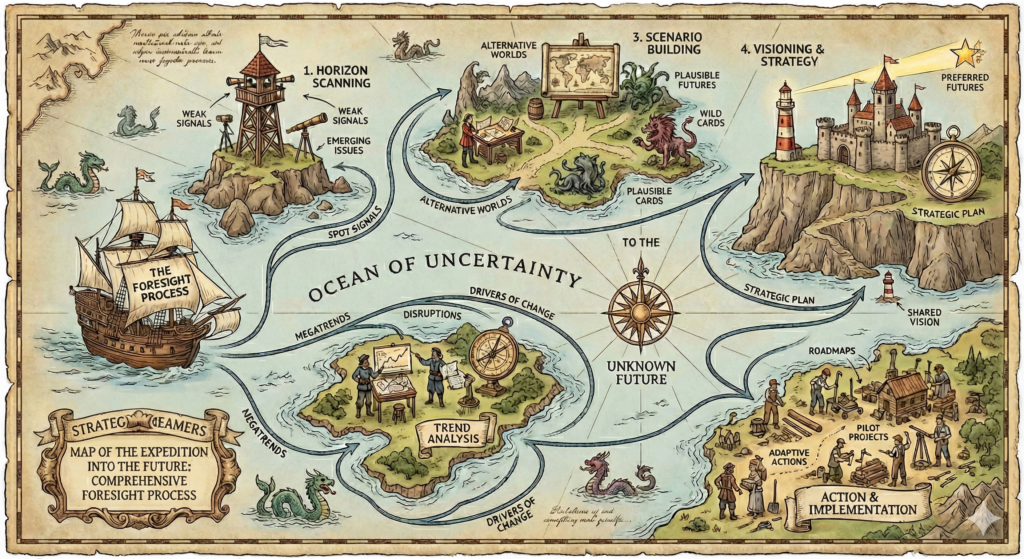
We design each program so that every stage produces outputs that are decision-relevant, not merely informative. A typical architecture includes:
- Scoping and Project Framing (Project Framing & Research Design)
- Horizon Scanning (Horizon Scanning + Signals Intelligence)
- Prioritization and Drivers Analysis (Drivers, Patterns, Cross-Impact)
- Key Uncertainties and Projections (Uncertainty Modeling)
- Scenario Construction (Oxford Scenario Planning + Manoa Method)
- Implications and Strategy Stress-Testing (Wind-Tunneling, Option Design)
- Expert Panels and Recommendation Building (Co-Creation)
- Backcasting, Roadmaps, Action Plans, Strategies, Policies
- Early Warning System and Ongoing Monitoring (Living Foresight)
- Futures Design Lab (optional): designing solutions and future artifacts
Each module can be deepened depending on scope, but the overall architecture remains coherent, implementable, and oriented toward outcomes.
Module I — Scoping and Project Framing
What we do
We establish a strong “epistemic contract” for the project—aligning the organization around a shared research and decision frame:
- Success criteria and deliverable formats: strategy, policy options, portfolio of initiatives, roadmaps, decision frameworks, innovation pipelines
- Decision context and strategic intent: what decisions this work must support
- Core research questions (e.g., “Under what conditions does X become the new norm?” “What risks are currently invisible to our model?”)
- Time horizons (3–5 years / 10 years / 15+ years) and geographies (local–regional–global)
- System boundaries: what is “inside” and “outside” the system under study
- Actor and stakeholder mapping: key actors, institutions, regulators, competitors, alliances, movements, infrastructures
- Key sources and evidence standards: what counts as signal vs trend vs noise; how credibility is assessed
How we do it (tools and practices)
- framing workshops and decision diagnostics
- systems mapping (dependency maps, causal loop thinking, value tensions and constraints)
- pre-mortems (how this project could fail and why)
- explicit identification of “blind spots” and cognitive risks (biases, institutional incentives, missing voices)
Outcome: a robust foresight project brief, research design, governance model, and shared working definitions—setting the foundation for high-quality scanning and scenario work.
What Horizon Scanning covers
We build a comprehensive “future-intelligence base” including:
- megatrends and macrotrends,
- sector trends and industry trajectories,
- emerging trends and pre-paradigmatic shifts,
- microtrends and localized practices,
- weak signals (early signals),
- disruptions, wild cards, and systemic shocks,
- regulation and institutional change,
- technology shifts, supply chain dynamics, infrastructure transitions,
- cultural shifts, behavioral change, new imaginaries, and contested narratives.
Signals Intelligence: a specific, distinctive approach
We treat signals differently from trends:
- Trend: an already structured, recognized directional pattern, mostly based on historical, past data,
- Weak Signal: a precursor – an anomaly, prototype, “strange case,” new practice, fringe innovation, or unexpected behavioral marker that may become significant if it matures,
- Disruption: an interference in system logic – altering value creation, power, governance, incentives, or dominant institutions.
Signals are handled as high-uncertainty / high-impact future intelligence. We classify them, cluster them into families, trace possible maturation pathways (from anomaly to norm), and connect them to plausible system shifts.
Ethnography in scanning – strengthened by AI and data analytics
Where “hard data” lags behind change, we use:
- micro-ethnographies and observation of practices (organizations, communities, professions, user groups),
- contextual interviews, shadowing, analysis of cultural and organizational artifacts,
- desk research and data sources (reports, academic literature, tech repositories, regulatory archives),
- AI-assisted methods (topic clustering, entity extraction, narrative mapping, anomaly detection, corpus analysis) – as augmentation, not replacement, of critical interpretation
Patentometrics (patent analytics): why it matters and where it fits
Patentometrics supports:
- early identification of technology trajectories before they become mainstream,
- mapping key players (firms, universities, consortia), strategies, and geographies,
- dynamics analysis (filing velocity, citations, patent families, convergence zones),
- detecting “white spaces” and strategic niches.
Patentometrics can be deployed either as a standalone methodological module or as an input that strengthens Horizon Scanning (and, where relevant, the drivers-analysis phase) – used selectively, when it is fit-for-purpose, to surface signals, provide robust context for projections, and illuminate competitive and institutional dynamics.
Outcome: a curated and structured scanning base – trends and signals with metadata, credibility notes, hypotheses, and relevance assessments.
Module III — Prioritization and Pattern Analysis: From Lists to System Logic
Horizon scanning produces breadth; foresight requires structure, selection, and causality.
Prioritization (multi-criteria)
We use multi-criteria prioritization such as:
- relevance to the client’s decision context,
- uncertainty and volatility,
- time horizon (near / mid / long),
- ETM – Earliest Time to Mainstream,
- TRL – Technology Readiness Level,
- scale (local to global),
- probability,
- impact (on the defined theme, organization, sector, field),
- reputational/regulatory sensitivity,
- alignment or tension with mission, values, and constraints.
The output is not “top 10 trends.” It is a set of strategic drivers of change with explicit justification.
Cross-impact analysis: mutual influence and feedback loops
Cross-impact analysis tests how drivers:
- reinforce or weaken each other,
- condition one another (A must happen for B to become possible),
- generate chains of effects and feedback loops.
This shifts the work from descriptive lists to a dynamic model of system behavior, which becomes the backbone of scenario construction and strategy stress-testing.
First-, second-, and third-order consequences
We systematically map:
- direct impacts (first-order),
- indirect effects and second-order consequences,
- systemic and long-range implications (third-order), including:
- unintended consequences,
- unexpected externalities,
- time delays and threshold effects,
- social, institutional, cultural, environmental spillovers,
- differentiated impacts across stakeholder groups.
Outcome: a structured “drivers landscape,” cross-impact logic, and consequence maps—ready to feed into uncertainty modeling and scenario design.
Module IV — Delphi Research: Calibrated Expert Intelligence
We use Delphi in three key ways:
- During scanning (validation and enrichment of signals, correction of blind spots, sensemaking across niche domains),
- During uncertainty modeling and projections (probabilities, conditions of occurrence, impact, timing ranges, tipping points, assumption stress-testing, causal chain validation, red-teaming and devil’s advocacy),
- During scenario validation (plausibility checks, narrative coherence assessment, blind spot identification, testing scenario boundary conditions, challenging embedded assumptions, evaluating scenario differentiation and coverage).
What Delphi is
Delphi is an iterative method for eliciting and calibrating expert judgments:
- anonymity (reducing status pressure and groupthink),
- multiple rounds or Real-Time Delphi (participants can revise positions),
- structured feedback (e.g., distributions of responses + rationales),
- outcome is not always consensus – sometimes a map of disagreement with reasons.
Why it works
- surfaces where experts converge and where they diverge,
- provides boundary conditions for scenarios (what is considered plausible/implausible and why),
- prevents domination by a single school, institution, ideology, or narrative
Outcome: calibrated projections and expert-grounded, assessed hypotheses that strengthen methodological defensibility.
Module V – Causal Layered Analysis (CLA): Depth, Culture, and Paradigm Change
CLA addresses a critical foresight truth: futures do not emerge only from data and technology, but also from language, values, and collective imaginaries. We work across four layers:
- Litany — headlines, symptoms, indicators, surface narratives,
- Systemic causes — institutions, economic structures, infrastructures, policy logics,
- Worldview / discourse — dominant frames, ideologies, norms, legitimacy regimes,
- Myth / metaphor — deep cultural stories and metaphors shaping sense-making.
CLA becomes especially valuable in contexts that are:
- strongly political or regulatory,
- trust-dependent (public legitimacy, contested expertise),
- culturally sensitive,
- shaped by competing value systems and moral economies.
Outcome: scenarios and recommendations that avoid technocratic simplification and reflect the deeper drivers of change – making them more realistic and implementable.
Module VI: Scenario Planning
Our Methodological Inspirations
Our approach to scenario building draws significant inspiration from two complementary schools of thought: the Oxford Scenario Planning Approach (OSPA) and the Manoa method developed by Wendy Schultz. Rather than mechanically combining these methods, we treat them as guiding frameworks that inform our practice and shape how we think about futures work.
What scenarios are and why they matter
Scenarios are not predictions, projections, or forecasts.¹ As Rafael Ramírez emphasizes, scenarios are “structured fictions”—plausible, purposeful accounts of possible future contexts.² They are designed to be useful, not truthful; they prioritize plausibility over probability.³ Their value lies not in correctly anticipating what will happen, but in helping organizations and communities reframe their understanding of the present and expand their capacity to perceive emerging possibilities.
Scenarios serve as “reframing supports”—safe conceptual spaces where multiple perspectives can surface, assumptions can be challenged, and new strategic options can emerge.⁴ They are always developed for someone, for a purpose, and with a specified use.⁵ This user-centered orientation helps avoid the trap of generic trend extrapolation disconnected from strategic action.
What can you do with scenarios? They enable stress-testing of strategies and policies across multiple possible futures, identification of robust options that perform well regardless of which future unfolds, early warning of emerging challenges and opportunities, and organizational learning that builds adaptive capacity.⁶ They also serve as powerful springboards for innovation design—by immersing teams in richly imagined future worlds, scenarios reveal unmet needs, emerging market spaces, and transformation opportunities that remain invisible when attention stays fixed on the present.
The Oxford Scenario Planning Approach: key inspirations
From OSPA, we draw several foundational principles:
The approach is explicitly learner-centered rather than decision-making centered—the goal is expanding perception and reframing understanding, not narrowly optimizing choices.⁷ Scenarios describe what might happen to the context in which an organization operates, distinct from the options available to the organization and the strategy it chooses to pursue.⁸
OSPA is explicitly designed for what Ramírez calls “TUNA situations”—conditions characterized by Turbulence, Uncertainty, Novelty, and Ambiguity.⁹ In such environments, traditional forecasting fails; scenarios become essential tools for navigating radical uncertainty.
The methodology emphasizes moving from the outer contextual environment (macro factors like geopolitics, technology, demographics) through the transactional environment (stakeholders, competitors, regulators) to the organization itself—a structured inquiry, drawing on the work of Kees van der Heijden, that keeps context at the center.¹⁰
The Manoa method
From Wendy Schultz’s Manoa method, we draw a different but equally valuable set of principles.
The Manoa approach emerged from a specific challenge: helping stakeholders understand the “so what?” of horizon scanning and emerging issues research.¹¹ Its design criteria specified that scenario processes should be participatory, firmly based in data, map steps by which change diverges from the present, include multiple drivers of change, and depict surprising outcomes across a generational time horizon.¹²
Central to Manoa is the principle that “the future is not binary”—our explorations deserve more than two axes.¹³ The method triangulates on initial difference to maximize resulting difference: each scenario begins with at least three emerging issues from different STEEP categories (Social, Technological, Environmental, Economic, Political), stated as mature conditions 20–30 years out.¹⁴ The greater the orthogonality in starting points, the greater the creativity generated through what Schultz calls “bisociation.”¹⁵
The method works through impact cascades. Participants explore each emerging issue by brainstorming primary impacts, then secondary impacts of those primaries, then tertiary impacts—creating futures wheels that trace chains of consequences.¹⁶ Because each scenario contains sets of impact cascades, it builds an inbuilt narrative of change over time, with tensions, conflicts, and sudden opportunities emerging at points where impacts intersect and collide.¹⁷
Schultz recommends probing for completeness across multiple domains of human experience: family structure, community, economy, governance, work, arts and leisure, vices and crimes, ecology, media and communication, transportation, education, subcultures, religion and myths, and core values and worldviews.¹⁸ In subsequent developments of the method, the addition of the Verge General Practice Framework helped ensure scenarios achieve what Schultz calls “integral depth.”¹⁹
The method asks practitioners to characterize scenarios through evocative devices—headlines that capture the tenor of the times, bumper-sticker phrases that capture essence, film or documentary titles.²⁰ This supports the development of vivid “day in the life” narratives that make future worlds experiential and memorable.²¹
Critically, Manoa follows Dator’s Second Law of Futures Thinking: “the only useful ideas about the future should appear to be ridiculous.”²² The method serves as an engine of creativity, drawing on processes identified by Edward de Bono: exaggerating impacts to absurdity, challenging assumptions about present conditions continuing, combining changes in ways that distort the familiar, and reversing current constraints or opportunities.²³
Why these inspirations work well together
OSPA provides conceptual discipline: the distinction between scenarios, options, and strategy; the emphasis on plausibility over probability; the structured movement from contextual to transactional environments; the learner-centered orientation that keeps scenarios connected to genuine reframing.
Manoa provides creative methodology: the triangulation on difference through multiple orthogonal changes; the impact cascade logic that generates inbuilt narratives; the insistence on imaginative stretch and assumption challenge; the attention to cultural texture and lived experience.
Drawing on both traditions, our scenario work aims to produce futures that are analytically grounded in emerging change while remaining experiential and culturally intelligible—scenarios that challenge assumptions while remaining connected to strategic action.
Outcome: scenarios that are simultaneously “for decisions” and “for imagination”—analytically grounded in driver logic and emerging change, culturally credible through narrative depth and lived-world texture, and practically usable for stress-testing strategies, designing innovations, and building organizational capacity to navigate uncertainty.
Module VII — Implications, Expert Panels, and Recommendation Building
Implications panels
For each scenario we identify:
- risks, opportunities, and challenges
- leverage points and intervention zones
- early warning signals (what to watch to detect drift into that future)
- differentiated impacts across stakeholder groups and institutional contexts
Recommendation panels (co-creation with experts)
We then convene expert and stakeholder panels to produce actionable recommendations:
- how to mitigate risks (resilience strategies)
- how to exploit opportunities anticipatorily (first-mover and positioning strategies)
- how to prepare for challenges (capabilities, processes, partnerships)
- how to reshape the rules of the game (policy instruments, standards, coalitions, legitimacy strategies)
At this point, the most powerful synthesis emerges from combining:
- analytical logic (cross-impact, consequence mapping),
- cultural and worldview work (CLA),
- decision design (option portfolios, prioritization, governance).
Outcome: recommendations that are robust across multiple scenarios—rather than optimized for a single forecast.
Module VIII — Strategy, Public Policy, and Action Plans: From Insights to Implementation
Depending on the client context, the foresight outputs are translated into:
- an organizational or program strategy
- a portfolio of initiatives (near-term wins + mid-term builds + long-term bets)
- a roadmap (milestones, dependencies, investment logic, capability needs)
- public policy options (regulatory pathways, instruments, implementation risks)
- decision criteria and governance mechanisms (how to decide under uncertainty)
- scenario-based stress-tests (“wind-tunneling”) of the current strategy
- innovation design (new products, services, business models, or social solutions surfaced through immersion in future worlds)
We often conclude with:
- backcasting (what must happen along the way),
- capability-building plans (skills, organizational capacities),
- partnership and coalition maps (who must be engaged to shape outcomes).
Outcome: a practical strategy system – ready for real-world execution under uncertainty.
Module IX: Early Warning and Monitoring (Keeping Strategic Foresight “Alive”)
To prevent foresight from becoming a sstatic report, we implement living foresight mechanisms:
- a curated set of indicators and observables (signals + metrics)
- review rhythms (e.g., quarterly updates)
- an update logic for scenarios and recommendations
- a signals repository and institutional memory
- decision thresholds: when to activate plan B/C, shift investments, or change policy posture
Outcome: foresight becomes an organizational capability—continuous, adaptive, and decision-linked.
Module X: Futures Design Lab
When the goal includes innovation, service transformation, organizational redesign, or culture change, we run a Futures Design Lab that:
- translates scenarios into prototypes (services, governance mechanisms, operational models, institutional processes)
- produces future artifacts (e.g., policy prototypes, service prototypes, operational mock-ups)
- tests prototypes with users/stakeholders and iterates
- builds tangible “future experiences,” increasing organizational readiness to act
This module often converts foresight into a concrete innovation pipeline and a set of “buildable” strategic moves.
Outcome: futures-driven design concepts, prototypes, and actionable development pathways.
Expert Engagement in Foresight Process
Throughout the process, we create tailored forms of expert engagement, including:
In-depth expert interviews (qualitative deep dives)
We conduct semi-structured and exploratory interviews to:
- surface tacit knowledge and “unwritten rules”
- validate signals and drivers
- map conflicts, interests, and institutional constraints
- identify boundary conditions for scenarios and recommendations
Expert panels and workshops
Used for:
- collective sensemaking and validation
- scenario co-creation
- implication mapping and recommendation building
- negotiation of strategic trade-offs and constraints
Ethnographic engagement
Applied to:
- user practices and behavioral change
- organizational cultures and institutional path-dependencies
- emerging norms that do not appear in conventional datasets
All of these are strengthened – where useful – by AI-assisted analytics and systematic evidence tracking, while preserving critical interpretation, foresight intuition and methodological rigor.
References
¹ Ramírez, R. (2024). Introduction to the Oxford Scenario Planning Approach [Presentation slides], Saïd Business School, University of Oxford, slide 28.
² Ibid., slide 32.
³ Ibid., slide 32; see also Ramírez, R. & Wilkinson, A. (2016). Strategic Reframing: The Oxford Scenario Planning Approach. Oxford University Press, pp. 160–161.
⁴ Ramírez (2024), slide 11.
⁵ Ibid., slide 21.
⁶ For standard applications of scenarios see: Ramírez & Wilkinson (2016); Schwartz, P. (1991). The Art of the Long View. Doubleday; Schoemaker, P.J.H. (1995). Scenario planning: A tool for strategic thinking. Sloan Management Review, 36(2), 25–40.
⁷ Ramírez (2024), slide 20.
⁸ Ibid., slide 8.
⁹ Ibid., slide 20.
¹⁰ Ibid., slide 19; van der Heijden, K. (2005). Scenarios: The Art of Strategic Conversation (2nd ed.). Wiley.
¹¹ Schultz, W. (2015). Manoa: The future is not binary. APF Compass, April 2015, p. 4.
¹² Ibid., p. 4.
¹³ Ibid., p. 8.
¹⁴ Ibid., p. 5 (Step One).
¹⁵ Ibid., p. 5.
¹⁶ Ibid., p. 5 (Step Two).
¹⁷ Ibid., p. 5.
¹⁸ Ibid., p. 5 (Step Four).
¹⁹ Ibid., p. 8; Lum, R. (2014). 4 Steps to the Future. Vision Foresight Strategy.
²⁰ Schultz (2015), p. 5 (Step Five).
²¹ Ibid., p. 6 (Step Six).
²² Ibid., p. 6 (Step Seven); see also Dator, J. (2007). What futures studies is and is not. In R. Slaughter (Ed.), Knowledge Base of Futures Studies. Foresight International.
²³ Schultz (2015), p. 6; de Bono, E. (2009). Lateral Thinking. Penguin.