Horizon Scanning & Signals Intelligence
See what’s forming before it becomes obvious
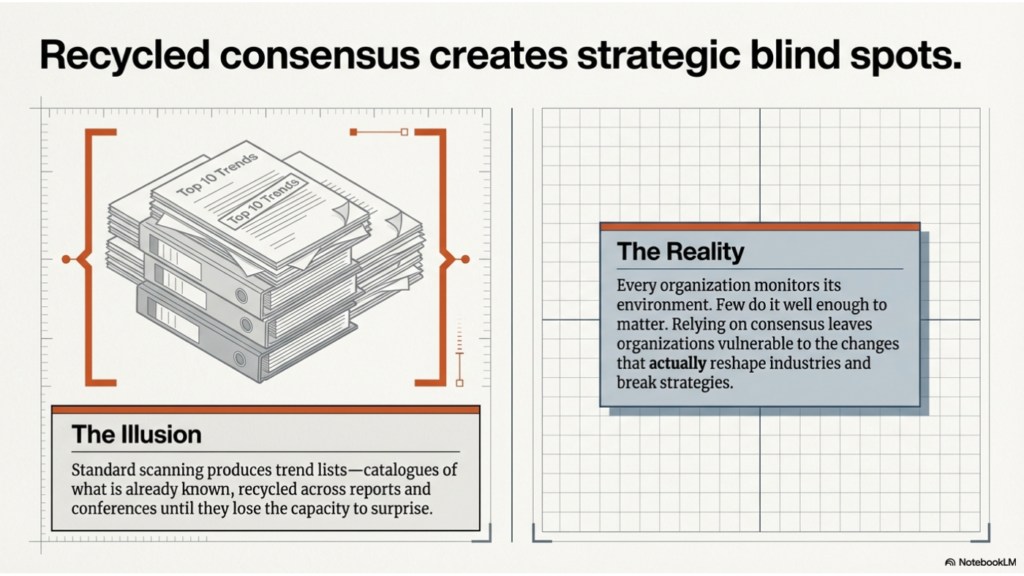
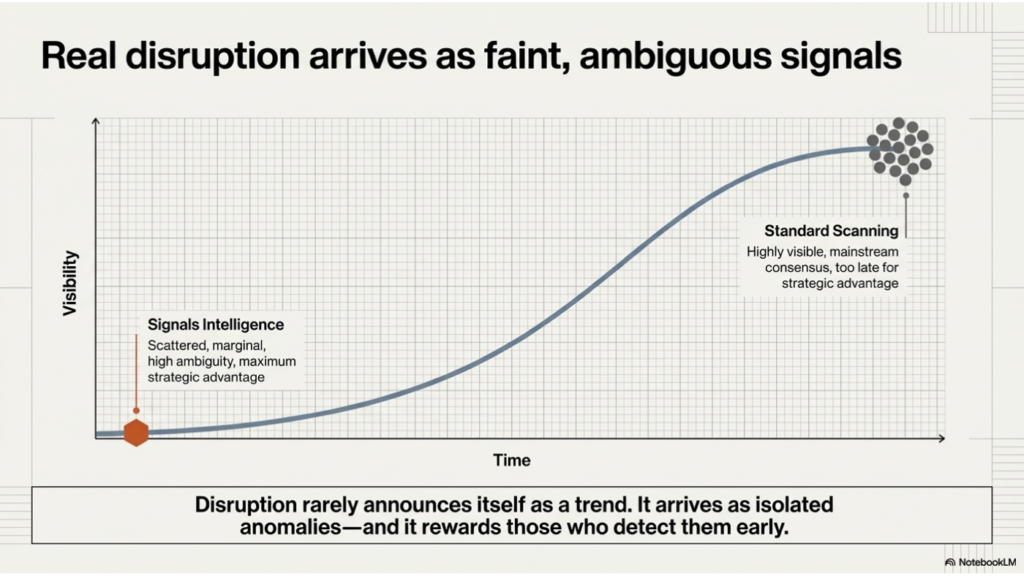
Every organisation monitors its environment. Few do it well enough to matter. Standard scanning produces trend lists — catalogues of what is already known, recycled across reports and conferences until they lose the capacity to surprise. But the changes that reshape industries, break strategies, and create new markets rarely arrive as “trends.” They arrive as faint, ambiguous, scattered signals — and they reward those who detect them early.
Horizon Scanning & Signals Intelligence is a continuously maintained sensing capability for organisations that want more than a trend report. We run scanning as a daily professional practice — tracking, interpreting, and connecting signals across technology, society, culture, and industry to build a living map of where change is forming and what it could become.
What makes this different
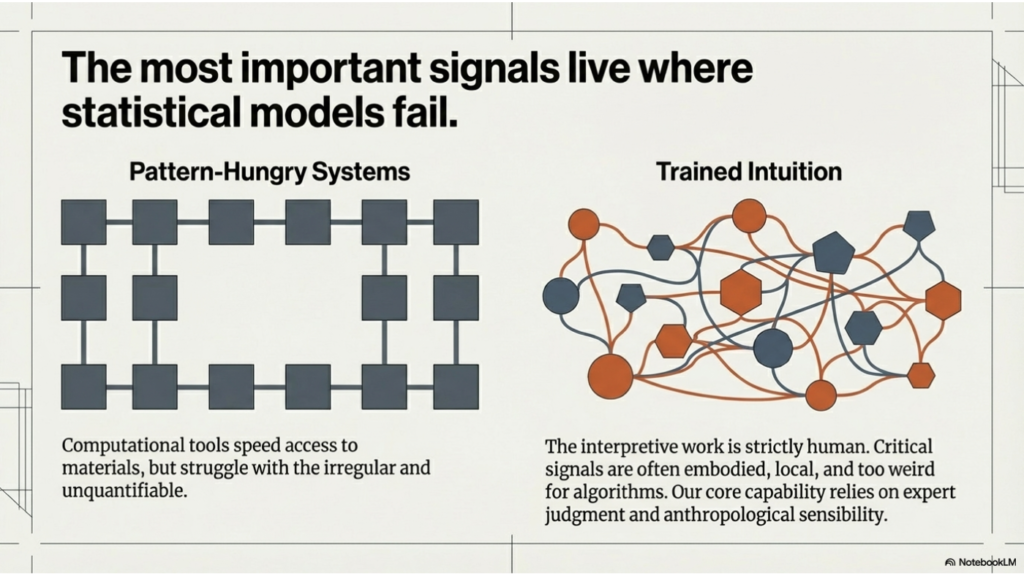
Human-led, not algorithm-driven. Our core capability is built on expert judgment, trained intuition, and anthropological sensibility — not on AI-generated trend lists. We use computational tools to speed access to materials, but the interpretive work is human. Why? Because the most important signals — marginal, local, embodied, “too weird” for pattern-hungry systems — live precisely where statistical models perform worst.
Field presence, not only desk research. We draw on ethnographic methods: visits to laboratories, conferences, hackerspaces, art and design festivals, and non-standard environments where change is happening before it’s being written about. Many signals don’t exist in textual form — they exist in practices, spaces, and behaviours. To detect them, you have to be there.
Patterns, not only catalogues. We don’t produce lists of “50 signals” or “top 10 disruptions.” We identify relationships: convergences where separate developments interlock and accelerate each other, divergences where change branches into plural futures, feedback loops, tensions, and systemic contradictions. The result is a set of constellations — maps of emerging change that already behave like systems.
Fresh signals, not recycled consensus. Our distinctive capability is discovering and prioritising what is genuinely new, surprising, and not yet mainstream. Signals can be behaviours, prototypes, narratives, economic anomalies, institutional micro-shifts, infrastructure traces, or system disturbances. They often sit at the margins — ignored or not yet legible within expert debate — until conditions align.
What you get
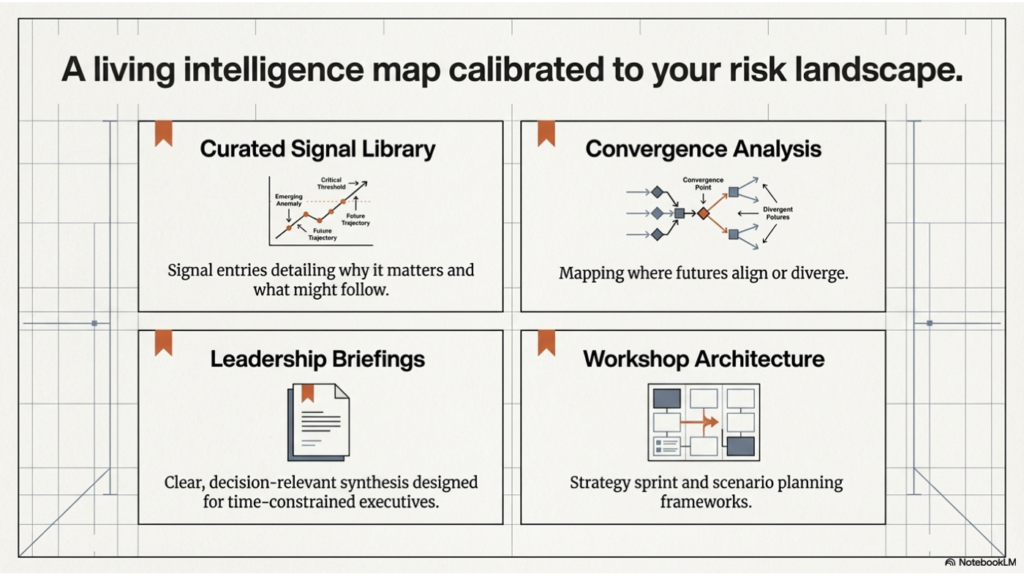
A dynamic intelligence map tailored to your sector, strategic priorities, and risk landscape — continuously updated, not a one-off deliverable.
Signal library with curated, annotated entries: each signal interpreted with “why it matters” and “what might follow.”
Convergence and divergence analysis showing where futures align, where they branch, and what that means for your strategic options.
Early-warning indicators — concrete signposts to monitor, with trigger criteria for when to act.
Briefings for leadership — clear, decision-relevant synthesis designed for time-constrained executives, not “trend theatre.”
Workshop-ready materials for scenario work, strategy sprints, and portfolio decisions.
How we work
We maintain ongoing awareness across evolving domains rather than starting from zero for each engagement. Our scanning draws from scientific literature and preprints, deep tech ecosystems, innovation pipelines, weak signals and anomalies, significant new books and long-form thinking, and direct field exposure.
For client-specific engagements, we calibrate scanning to your sector, technology stack, regulatory environment, geopolitical exposure, and cultural context. We track megatrends, mid-scale trends, declining trends, disruptions, and weak signals — but our emphasis is always on what comes next.
Formats
- Subscription service (retainer): Regular signal updates + monthly syntheses + quarterly deep-dives
- Project mode (6–10 weeks): Intensive scan + pattern mapping + strategic implications + recommendations
- Executive briefings: Short, frequent intelligence sessions for leadership teams
- Integration with foresight programmes: Scanning as the first stage of a Comprehensive Foresight Programme or Futures Design Lab engagement
Who this is for
- A strategy team that needs to see beyond its sector’s consensus narrative.
- A regulator preparing for the next wave of disruption.
- A leadership team building anticipatory capability rather than reactive posture.
- An innovation function looking for breakthrough directions that don’t appear in standard reports.
- An EU institution or international organisation that needs intelligence on emerging risks and opportunities.