Futures Design Lab
The future is not something to predict. It’s something to design.
To shift decisions, futures need to become tangible — something you can see, hold, walk through, and argue about.
Futures Design Lab is where futures are made, not just mapped. We combine strategic foresight, design fiction, systemic design, and anthropological fieldwork to create experiences and prototypes that make possible worlds concrete — so your team can examine them, challenge them, and use them to make better choices today.
What you get
Prototypes from possible worlds
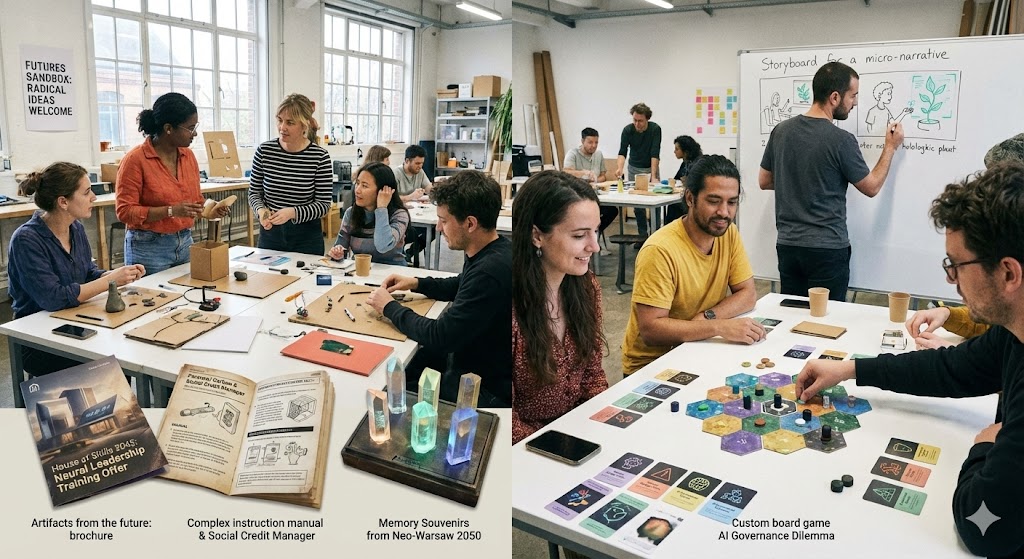
Physical or digital artifacts “from the future” — products, interfaces, documents, environments — that function as material arguments. Not illustrations of a trend report, but working pieces of evidence: objects you can show to your board, test with users, or use to provoke a strategic conversation that abstract slides never could.
Immersive experiences
Simulations, narrative environments, and workshop formats where your team “inhabits” an alternative future. This tangibility changes how people engage: instead of debating generalities, they confront concrete choices, trade-offs, and consequences — and discover assumptions they didn’t know they were making.
Future narratives as strategic infrastructure
We design narratives that work both outward and inward: strengthening external positioning (“what future are we helping to build?”) and internal alignment (shared direction, cultural coherence, decision clarity). These are not marketing stories — they are strategic instruments grounded in values, consequences, and real organisational trade-offs.
Innovation across scales
We work from micro-improvements (service refinements, product concepts, operational prototypes) to transformational interventions (new value logics, partnership ecosystems, institutional redesign). Both at once, because organisations need short-term wins and long-term adaptive capacity simultaneously.
How we work
Three connected rhythms — often combined:
1. Sense-making
Horizon scanning, pattern detection, systemic mapping, identification of “pockets of tomorrow.” We read signals not as isolated data points, but as relational phenomena — connected through infrastructures, narratives, markets, and cultural shifts.
2. Translation
Scenarios, decision architecture, narrative design, strategic options. We convert what we’ve found into frameworks your team can use to decide and act.
3. Prototyping & rehearsal
Design fiction artifacts, service prototypes, immersive simulations, speculative experiences. Futures as something you can try on, critique, and iterate — not just read about.
What sets this apart
This is the most experimental format in our portfolio — and the one that most powerfully shifts how people think. We draw on curatorial, artistic, and anthropological traditions that most consultancies don’t touch. The result is work that engages imagination at a level that slides and spreadsheets cannot reach — while remaining grounded in strategic rigour and decision relevance.
If your challenge requires conventional scenario planning, start with our Strategic Foresight & Scenario Planning Process. Come here when you need a breakthrough — when the problem isn’t lack of data, but lack of imagination.
Formats
- Research-design project (1–4 months): From signals to prototypes to strategic recommendations
- Immersive lab / workshop (1–3 days): Intensive futures-making experience for teams
- Exhibition / installation: Designed futures as public or internal communication
- Prototype studio: Rapid concept development from foresight insights
Who this is for
- An FMCG brand looking for breakthrough product innovation beyond incremental improvement.
- A cultural institution designing its programme and identity for the next decade.
- A city running a participatory process about a neighbourhood’s future.
- An international organisation communicating complex scenarios to diverse audiences.
- An innovation team that has hit the ceiling of conventional thinking and needs a fundamentally different approach.
Start designing your future
Counter Visuality Futures Lab and the politics of imagination
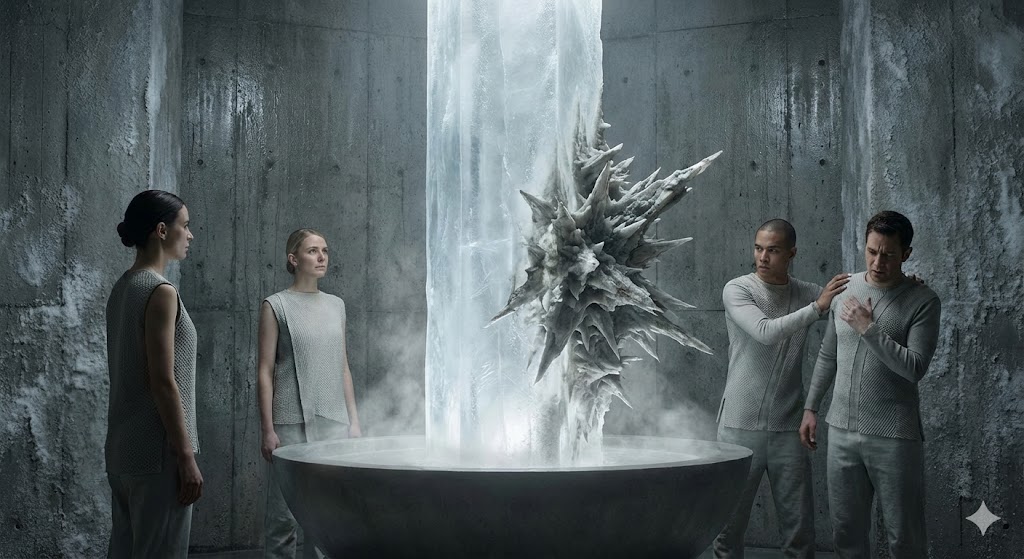
Futures Design Lab also functions as a practice of imagination—working from micro-improvements to systemic redesign, sometimes at social, infrastructural, and even planetary scales.In this sense, prototyping alternatives is a political act in the best meaning of the word: it expands the space of decision, and reduces dependency on futures “installed” by dominant interests.