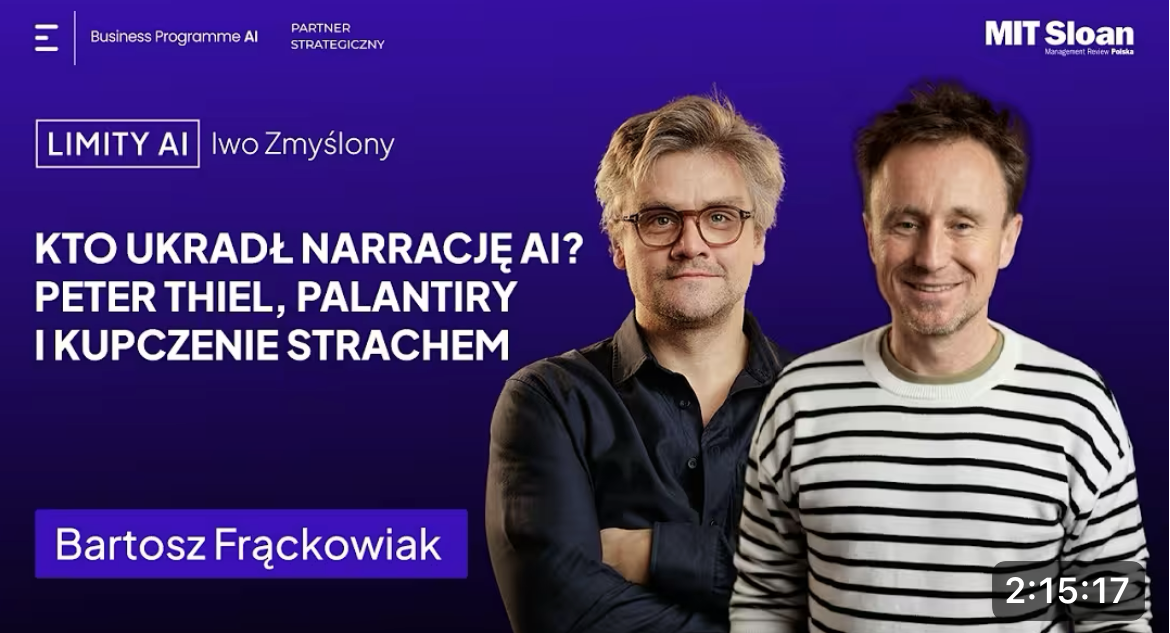
Bartek Frąckowiak from Strategic Dreamers in conversation with Iwo Zmyślony on AI, Palantir, Peter Thiel and the politics of technological imagination
Artificial intelligence is rarely just a conversation about technology.
It is also a conversation about power, fear, prediction, security, capital, governance and the shrinking space of political imagination. The way we talk about AI increasingly determines what kinds of futures are considered realistic, necessary or inevitable as well as which alternatives are dismissed before they can even be properly imagined.
In the podcast “Limits of AI: 2026”, Iwo Zmyślony invited Bartek Frąckowiak from Strategic Dreamers to discuss the forces shaping today’s dominant narratives around artificial intelligence. The conversation moves through Peter Thiel, Palantir, techno-libertarianism, predictive security infrastructures and the growing tendency to sell the future as a security product.
But the episode is also about the possibility of reclaiming imagination.
At Strategic Dreamers, we work with foresight and futures design not as exercises in prediction, but as practices for interrogating the present and opening up alternative trajectories. We are interested in how technologies are embedded in institutions, business models, cultural imaginaries and political systems as well as how different futures can be designed before the existing ones harden into common sense.
The central question, then, is not simply whether AI will be beneficial or dangerous.
The more urgent question is: who gets to define what AI is for?
Who decides that the future must be framed as a race, a battlefield, a risk map or a dashboard? Who benefits when fear becomes the dominant grammar of technological change? Who gets to present their own strategic interests as inevitability? And what happens to democratic agency, social imagination and collective life when prediction becomes the preferred language of governance?
The conversation with Iwo Zmyślony explores AI as part of a broader transformation in how societies imagine safety, uncertainty and control. Systems such as Palantir are not only technical platforms; they also represent a particular worldview. They imply that the world is best understood as a field of hidden patterns, threats and anomalies to be detected before they fully appear. In such a worldview, the future becomes something to be pre-empted rather than collectively negotiated.
This matters because technological narratives are never neutral. They organise attention. They set priorities. They legitimise investments. They define enemies and emergencies. They shape what policymakers, institutions, companies and citizens believe to be possible.
When AI is narrated through fear, competition and control, the range of imaginable responses narrows. More surveillance appears rational. More automation appears inevitable. More predictive infrastructure appears responsible. The social and political choices behind these systems disappear behind the language of necessity.
This is precisely where foresight and futures design become important.
For Strategic Dreamers, foresight is not only a strategic tool for anticipating change. It is also a cultural and political practice: a way of examining the assumptions, metaphors, infrastructures and power relations that structure the future before it arrives. Futures design allows us to materialise alternatives: through scenarios, speculative artefacts, policy prototypes, institutional models and narratives that make other possibilities tangible.
This dual movement is crucial.
We need critique to understand how existing technological systems reproduce control, inequality, militarisation or extractive forms of value. But critique alone is not enough. Without alternative images, concepts and designs, we remain trapped inside the future imagined by others.
The work of Strategic Dreamers is therefore located between diagnosis and invention. We analyse the dominant systems shaping technological change, but we also help organisations, institutions and communities imagine different futures: different models of security, different relationships with data, different forms of governance, different infrastructures of trust, different ways of organising collective intelligence.
AI does not have one future.
It has many possible futures, shaped by competing interests, cultural assumptions, regulatory choices, institutional arrangements and social struggles. Some of these futures will deepen asymmetries of power. Others may support more democratic, plural and life-enhancing forms of coordination. None of them will emerge automatically.
They have to be imagined, debated, designed and fought for.
The conversation between Iwo Zmyślony and Bartek Frąckowiak is an invitation to look beyond the surface of the AI debate. Beyond the spectacle of acceleration. Beyond the binary of salvation and catastrophe. Beyond the idea that the future is something already decided by the most powerful actors in technology.
The most important question is what kinds of worlds we are still capable of imagining before someone else’s future becomes our everyday life.