The first sign is often banal: a meeting request with “AI strategy” in the title.
By then, something has already happened. Someone in the organization has been using generative tools quietly for months. A manager has praised an AI-generated synthesis because it sounded clean enough to be true. A client has asked why the company is not moving faster. A competitor has published a case study, polished to the point where no one can see the mess behind it. A vendor deck has begun to circulate. The future has entered the building before anyone has agreed what to call it.
This is where strategic foresight for AI transformation becomes more than a method. It becomes a form of organizational self-defence against a future that arrives already disguised as inevitability.
When the Future Enters Through the Side Door
Strategic Dreamers contributed to the mysource report “Insights 2026: The Human Edge | Wellbeing as a Catalyst for AI Transformation” with Bartosz Frąckowiak’s chapter: “Foresight as an Organizational Competence: Before the Future Becomes a Constraint.”
The phrase is not decorative. It names a very ordinary organizational condition.
There is still a decision-making process. There are still meetings, slides, approvals, pilots, budgets. Yet the real field of choice has already narrowed. AI is no longer one possible direction among others. It has become pressure: from the market, from clients, from employees, from the board, from the strange managerial fear of being late to something no one fully understands.
At that point, organizations often begin to behave as if the future had already been decided elsewhere.
They do not say this explicitly. They say: we need to keep up. We need to accelerate. We need a roadmap. We need a governance model. We need productivity gains. None of these sentences is wrong. That is precisely why they are dangerous. They are reasonable enough to hide the deeper question: what version of the future have we already accepted without noticing?
Strategic foresight for AI transformation starts before the roadmap. It begins where the official conversation usually does not want to stay for too long: with assumptions, unease, resistance, dependency, fragile competence, and the possibility that the most efficient future may also be a poorer one.
The Comfort of One Scenario
Organizations like one future.
One future is easier to budget. Easier to present to the board. Easier to translate into milestones. Easier to sell. Easier to measure. It allows everyone to speak in the calm voice of implementation.
AI will increase productivity. AI will automate routine tasks. AI will free people for higher-value work. AI will make the organization faster, smarter, more adaptive. The sentence is smooth. Too smooth.
The problem is not that this future is impossible. Parts of it are already happening. The problem is that a single scenario behaves like a corridor. Once inside, the organization starts to confuse movement with direction.
AI transformation will not unfold as one clean story. It will be jagged, uneven, culturally specific, emotionally difficult, and full of strange asymmetries. A tool may be impressive in one task and useless in another. It may strengthen one team while weakening another. It may save time and increase vigilance. It may remove friction and remove apprenticeship with it. It may produce documents faster while making thought harder to locate.
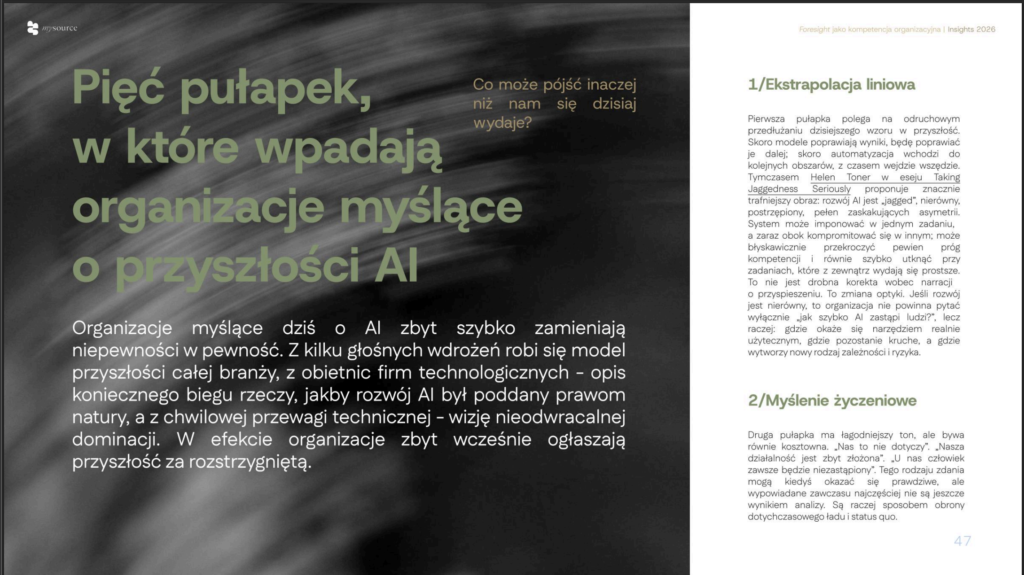
This is why the chapter examines five traps that make AI futures appear more settled than they are:
- linear extrapolation,
- wishful thinking,
- technological determinism,
- underestimating human resistance, and
- the single-scenario horizon.
They are not spectacular failures. They often look like competence.
A confident forecast. A benchmark. A vendor promise. A graph. A neat transformation narrative. A sentence beginning with “the direction is obvious.”
Foresight interrupts that tone.
Not by claiming to know the future, but by refusing to let one version of it occupy the whole room.
Strategic Foresight for AI Transformation Is a Practice of Suspicion
The first trap, linear extrapolation, is the habit of extending today’s pattern forward. If AI writes faster now, the future of writing must be faster writing. If AI automates tasks now, the future of work must be more automation. It sounds rational because it begins with evidence. Yet the future often breaks exactly where the line looks strongest.
The second trap, wishful thinking, is softer but no less costly. AI becomes a screen onto which organizations project their unresolved desires. It will reduce overload. It will make people creative. It will solve inefficiency. It will let everyone focus on “higher-value work.” Almost no one asks what disappears when lower-value work is removed: the slow learning, the mistakes, the repetitive contact with material through which expertise is formed.
Technological determinism goes further. It treats capability as destiny. Because AI can do something, the organization must adapt to it. Choice disappears. Strategy becomes obedience with a better vocabulary.
Then comes resistance. Most organizations dislike resistance because it interrupts the preferred story of change. Resistance is treated as fear, low maturity, poor communication, lack of digital competence. Sometimes it is. But sometimes resistance is the most precise intelligence in the room. It may know that the transformation narrative does not match everyday work. It may sense that a promise of empowerment is really a system of control. It may hear the human cost before the dashboard does.
The final trap is the single scenario: the quiet belief that one plausible future is enough to organize action. It is not. One scenario may calm the organization, but it also makes it brittle.
Strategic foresight for AI transformation is a practice of suspicion toward these comforts. It asks what is being smuggled into the organization together with the tool. Which habits of judgment will no longer be practiced. Which forms of work will be made invisible because they do not look efficient. Which dependencies are being built while everyone is still celebrating acceleration.
Weak Signals Do Not Look Like Strategy
The future rarely begins as a trend report.
It begins as a workaround. A joke. A silence after a meeting. A manager who cannot tell whether a polished summary is accurate. A team producing more content and understanding less. A worker using AI at night to meet a deadline that will later be treated as reasonable evidence of improved productivity.
At first, these are not data points. They are disturbances.
Most organizations are bad at disturbances. They prefer signals that have already become visible at scale: adoption rates, market benchmarks, regulatory developments, customer expectations, competitor moves. These matter, but they are late. By the time something appears in a dashboard, it has often already reorganized behaviour.
Weak signals are not weak because they are unimportant. They are weak because the system has not yet learned how to see them.
This is one reason why foresight cannot be reduced to prediction. Prediction wants the future to become an object. Foresight trains attention before the object is stable. It works with anomalies, early tensions, fragile patterns, cultural symptoms, marginal practices, and questions that do not yet have a department assigned to them.
In AI transformation, this kind of attention is indispensable. The most important signals may not appear in technology metrics at all. They may appear in fatigue, shame, hidden use, over-reliance, quiet deskilling, or the strange confidence people develop toward outputs they no longer know how to verify.
Wellbeing Is Not a Soft Add-On
The title of the mysource report places wellbeing next to AI transformation. This could easily sound like corporate softness: a human word positioned beside a hard technology.
But wellbeing becomes strategic when we understand it as a condition of perception.
An exhausted organization sees less. It simplifies faster. It imitates more readily. It clings to one scenario because alternatives require energy. Leaders under pressure do not automatically become more visionary; often they become more dependent on what can be measured quickly.
A burned-out team can still fill a futures canvas. It can still vote on uncertainties. It can still produce a set of scenarios. But the deeper work of foresight – staying with ambiguity, allowing disagreement, noticing weak signals, resisting false certainty – requires cognitive and emotional reserves.
AI does not enter a neutral organization. It enters a workplace with old hierarchies, fragile trust, heroic overwork, hidden incentives, managerial fantasies, and unresolved conflicts about control. If those conditions remain unnamed, the technology will not bypass them. It will amplify them.
This is why strategic foresight for AI transformation must pay attention to wellbeing without turning it into ornament. The state of people is not background noise. It shapes what AI becomes inside the organization.
The Future Cannot Be Outsourced
There is a final discomfort.
Organizations often outsource thinking about the future. They commission reports, invite experts, buy access to trend platforms, run scenario workshops. This can be useful. Strategic Dreamers does this work, and external perspective can open a room that has become too accustomed to its own air.
But there is a line.
When an organization outsources future-thinking entirely, it does not build foresight. It rents imagination.
It receives scenarios, but not necessarily the capacity to create them. It receives language, but not necessarily the habit of asking better questions. It receives a map, but not the sensitivity to notice when the territory begins to move.
Foresight becomes organizational only when it enters meetings, leadership habits, research practices, product choices, people strategy, risk conversations, and budget conflicts. As organizational muscle.
This is especially urgent now because AI systems are extraordinarily good at processing what has already been captured: text, images, decisions, preferences, patterns, archives, traces. They work on the world made legible.
But the future often begins in what is not yet legible.
A weak signal. A refusal. A misuse. A discomfort. A strange new phrase. A form of work disappearing so quietly that no one notices what kind of intelligence disappears with it.
The more powerful our tools for processing the known become, the more valuable our capacity to work with the not-yet-known may be.
The next time someone says “we need an AI strategy,” the first response should not be a roadmap.
It should be a pause long enough to ask: which future are we already obeying?