Speculative Foresight in Action: Security Without Fear at PolyFutures Brussels
European Commission Joint Research Centre / EU Policy Lab | Speculative Foresight Workshop
From a critique of securitisation to speculative policy artifacts for European public governance.
Challenge
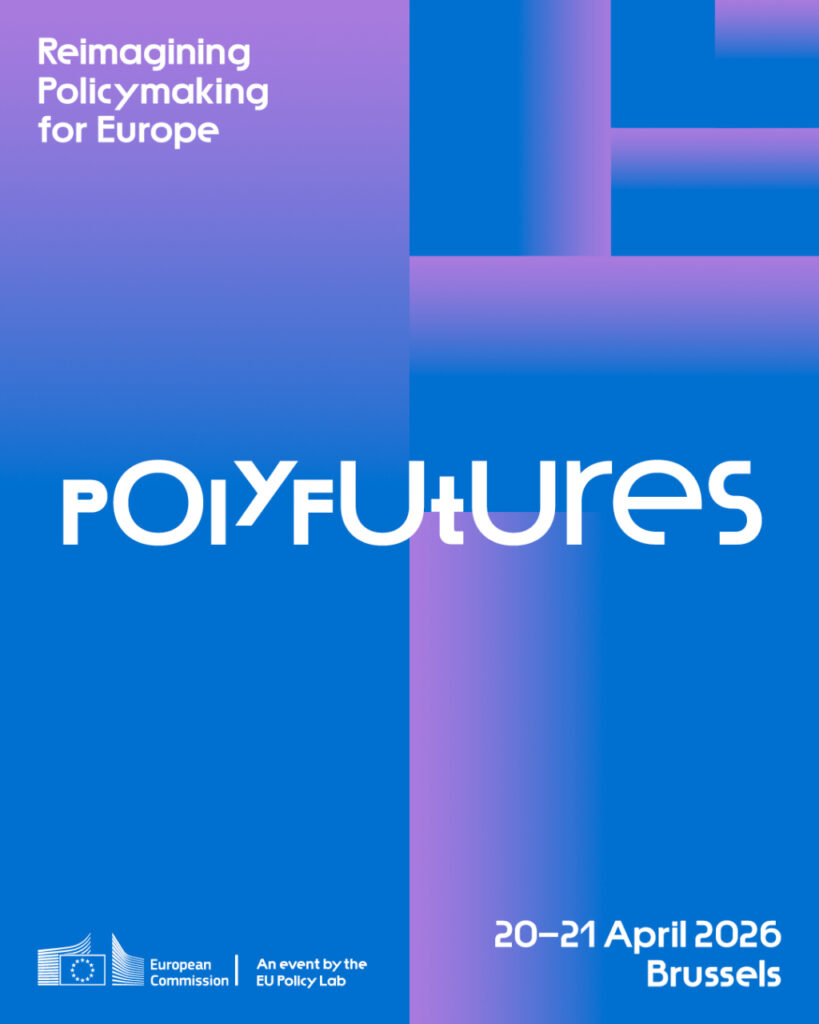
A conference badge can carry an institutional question before anyone has spoken. At PolyFutures – Reimagining Policymaking for Europe, held in Brussels on 20-21 April 2026 by the EU Policy Lab, part of the European Commission’s Joint Research Centre, the question was not only how public institutions can anticipate change. It was how European policymaking can work with futures without reducing them to risk registers or emergency scripts.
Security was a charged terrain for that question. AI, synthetic biology, biometric access, ambient sensing, platformised defence technologies and data fusion are changing how institutions detect and classify danger. Yet the deeper problem is the expansion of security as a language entering health, welfare, mobility, communication, borders, public space and infrastructure – often turning ordinary life into a field of verification and suspicion.
The methodological difficulty was precise: how to run foresight on security without reproducing the habits of security governance itself. A conventional risk workshop can intensify the grammar it claims to analyse: more threat, more anticipation, more control. Security Without Fear was designed as a counter-move, asking whether European public security could be rights-preserving, accountable and capable without becoming a machine for producing fear.
The process had to meet five requirements:
- maintain critical distance from dominant security frames while remaining useful for policy practitioners;
- move from critique to propositions that could be discussed, contested and modified;
- produce policy artifacts rather than only verbal scenarios;
- hold together technological, legal, affective, infrastructural and democratic dimensions of security;
- allow disagreement among participants without forcing premature consensus.
Approach
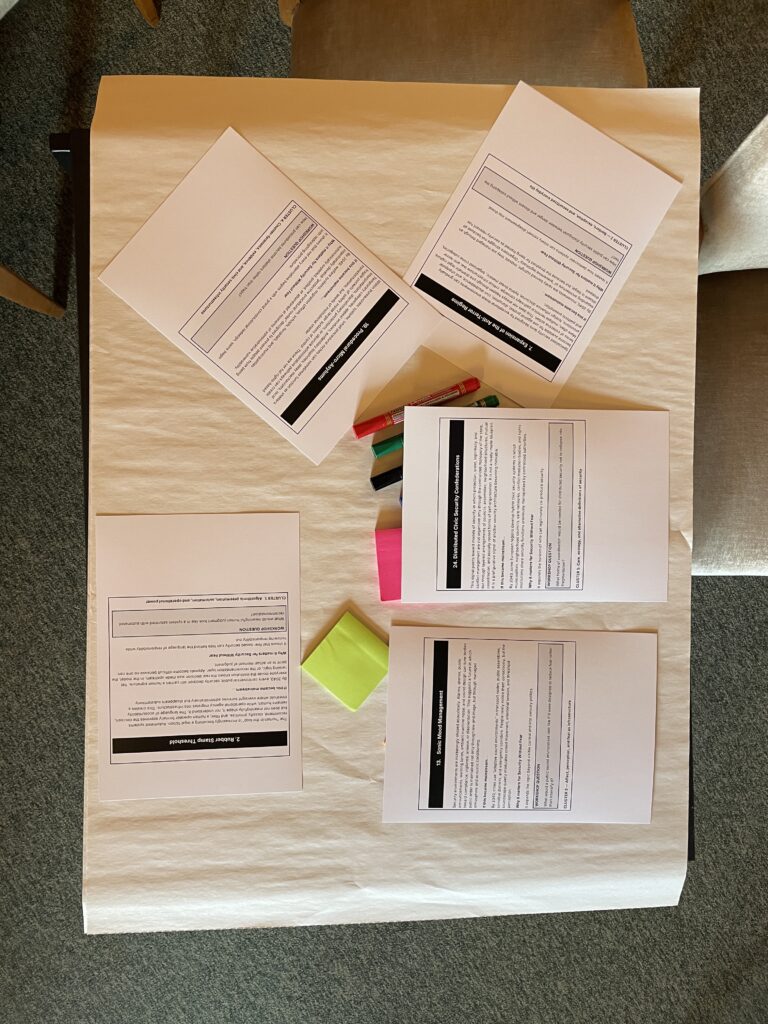
1) Horizon scanning and weak signal cataloguing. The preparation phase assembled weak signals around the changing infrastructures of security: predictive pre-emption, rubber-stamp human oversight, data shadows, AI-exempted border zones, anti-terror regime expansion, affective securitisation, civic counter-forensics, material witnessing, low-extraction care and the right to breathe as security infrastructure. The catalogue was organised as a set of tensions: operational power, everyday bordering, affective governance, civic evidence, ecological safety and alternative definitions of protection.
2) Critical reframing of securitisation. Before participants imagined futures, the workshop made the security frame itself available for inspection. Drawing on securitisation theory, critical security studies, counter-visuality and the politics of the imaginable, we treated security as performative. A wall, checkpoint, biometric gate or high-alert message does not simply reduce threat. It teaches society what danger should look like, who must be watched, and which restrictions can be accepted.
3) Manoa-based scenario construction. The workshop used a Manoa-inspired sequence in which selected emerging issues were combined and pushed into second- and third-order consequences. Participants began with signals that disturbed each other: predictive pre-emption colliding with civic counter-forensics, or border-as-a-service meeting low-extraction care. Through cross-impact reasoning, these combinations became 2040 worlds rather than linear extrapolations or dystopian postcards.
4) Speculative design and policy artifact prototyping. Scenarios were not treated as final products. They became worlds from which artifacts could be brought back: prototype regulations, civic formats, institutional procedures, infrastructural mock-ups, public notices, rights-preserving verification systems or evidence protocols. An artifact makes a future arguable: who would use it, who would be excluded, what would it reveal, and what legitimacy would it require?
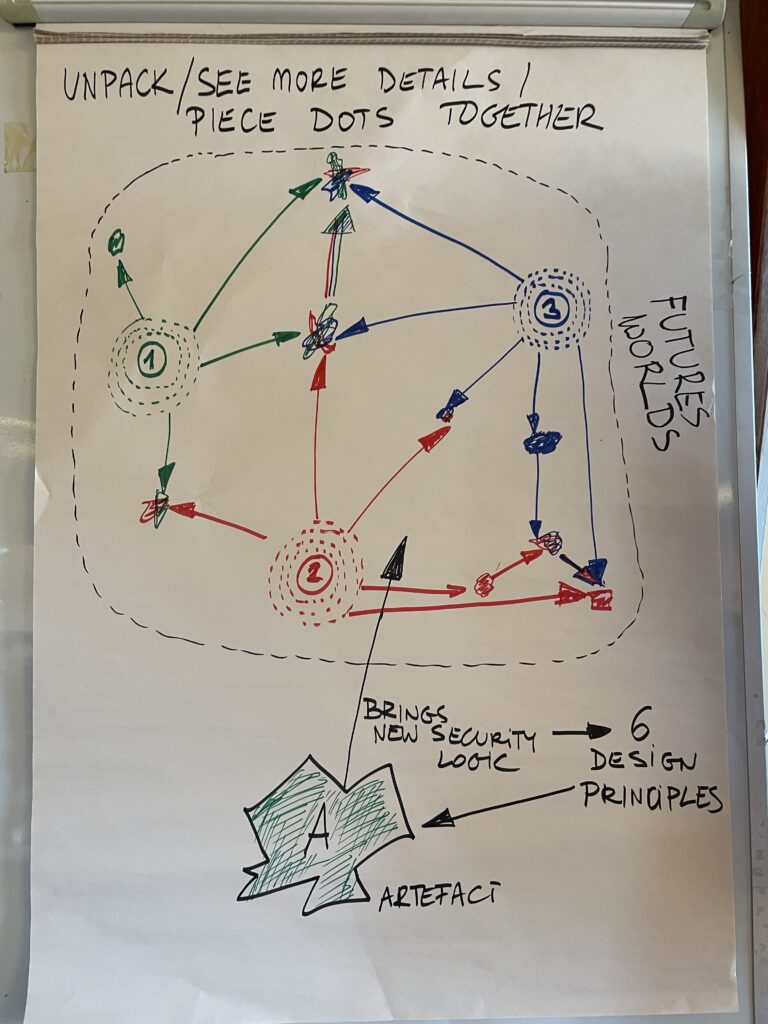
5) Deliberation and policy-relevance test. The final layer returned the speculative material to public governance. The point was not ready-made recommendations, but alternative security assumptions tangible enough to be examined by people working close to policy.
Outcome
Security Without Fear produced a shared space for thinking about European security beyond the reflex of hardening. The workshop did not ask participants to deny sabotage, disinformation, infrastructural violence, biosecurity risks or hybrid threats. It asked what follows if public security begins from a different premise: fear is not a civic resource to be endlessly mobilised, and preparedness loses democratic value when it colonises everyday life.
The collective output can be read as a portfolio of possible security logics rather than a single strategic line: stronger civic evidence infrastructures, rights-preserving borders, non-extractive coordination systems, public environments designed to reduce fear, and preparedness that builds capacity without permanent alarm.
- a curated weak-signal corpus for European security futures, structured across algorithmic, border, affective, forensic and ecological clusters;
- a body of speculative policy artifacts including prototype regulations and civic formats;
- policy-relevance reflections for future work with EU institutions on anticipatory governance and democratic security.
Scale
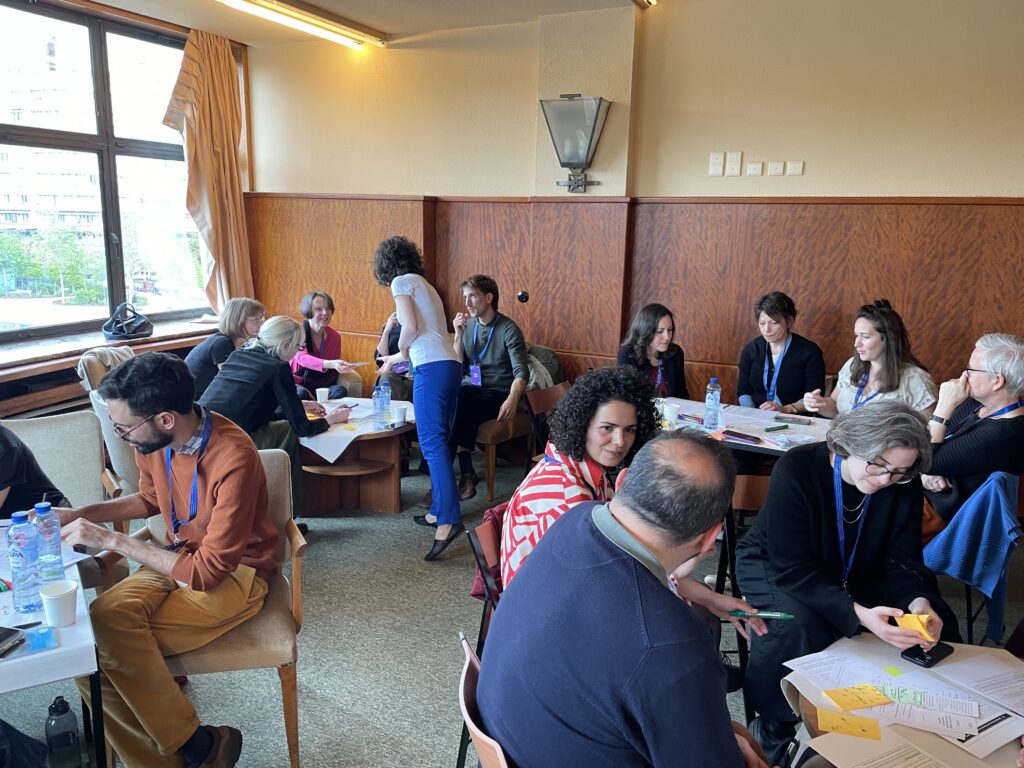
- Developed for PolyFutures – Reimagining Policymaking for Europe, Brussels, 20-21 April 2026, an EU Policy Lab conference hosted within the European Commission’s Joint Research Centre context.
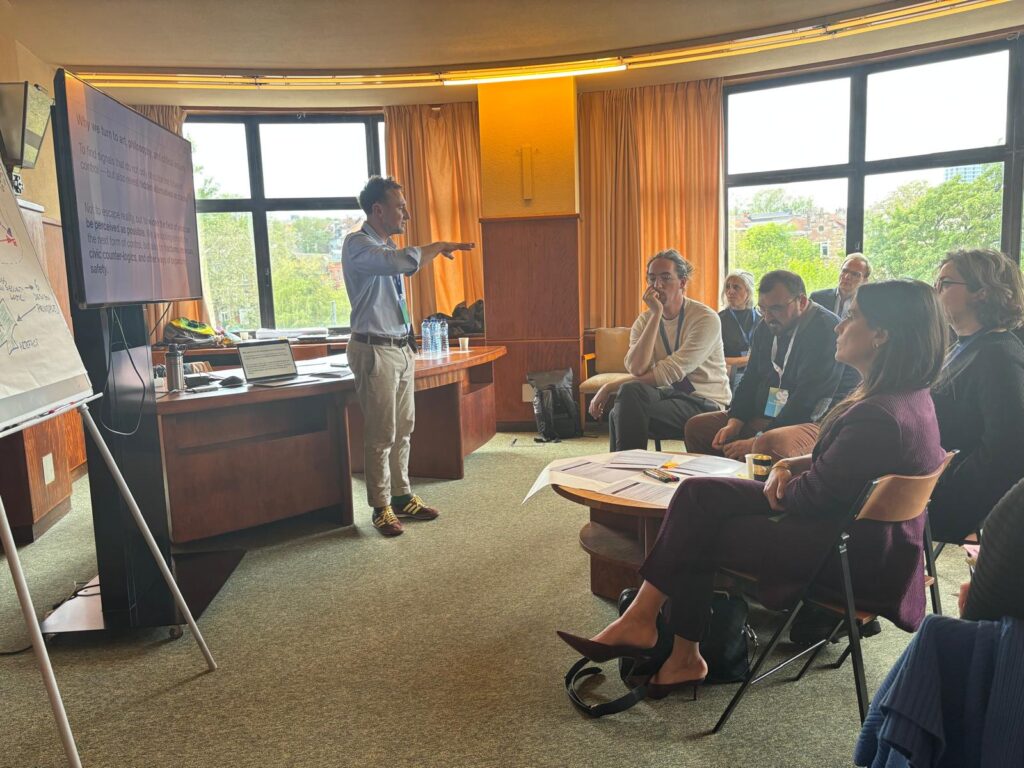
- Facilitated by Bartosz Frąckowiak and Katarzyna Figiel from Strategic Dreamers, drawing on experience in strategic foresight, futures literacy, scenario design, speculative methods, cultural analysis, technology critique and policy-oriented facilitation.
- Designed for a mixed European public-governance audience of policy officers, researchers, foresight practitioners, designers and institutional actors working with uncertainty, technological change and democratic pressure.
- Positioned as a contribution to European security foresight that moves from critique to materialisation: from weak signals and critical reframing to policy artifacts that can be discussed inside public institutions.
About the authors
Bartosz Frąckowiak is a strategic foresight practitioner, curator and researcher working across futures studies, technology, culture and public institutions. Katarzyna Figiel is a foresight and futures literacy practitioner with experience in European innovation and participatory methodologies. Together at Strategic Dreamers, they develop foresight processes that connect analytical rigour with speculative and democratic imagination.