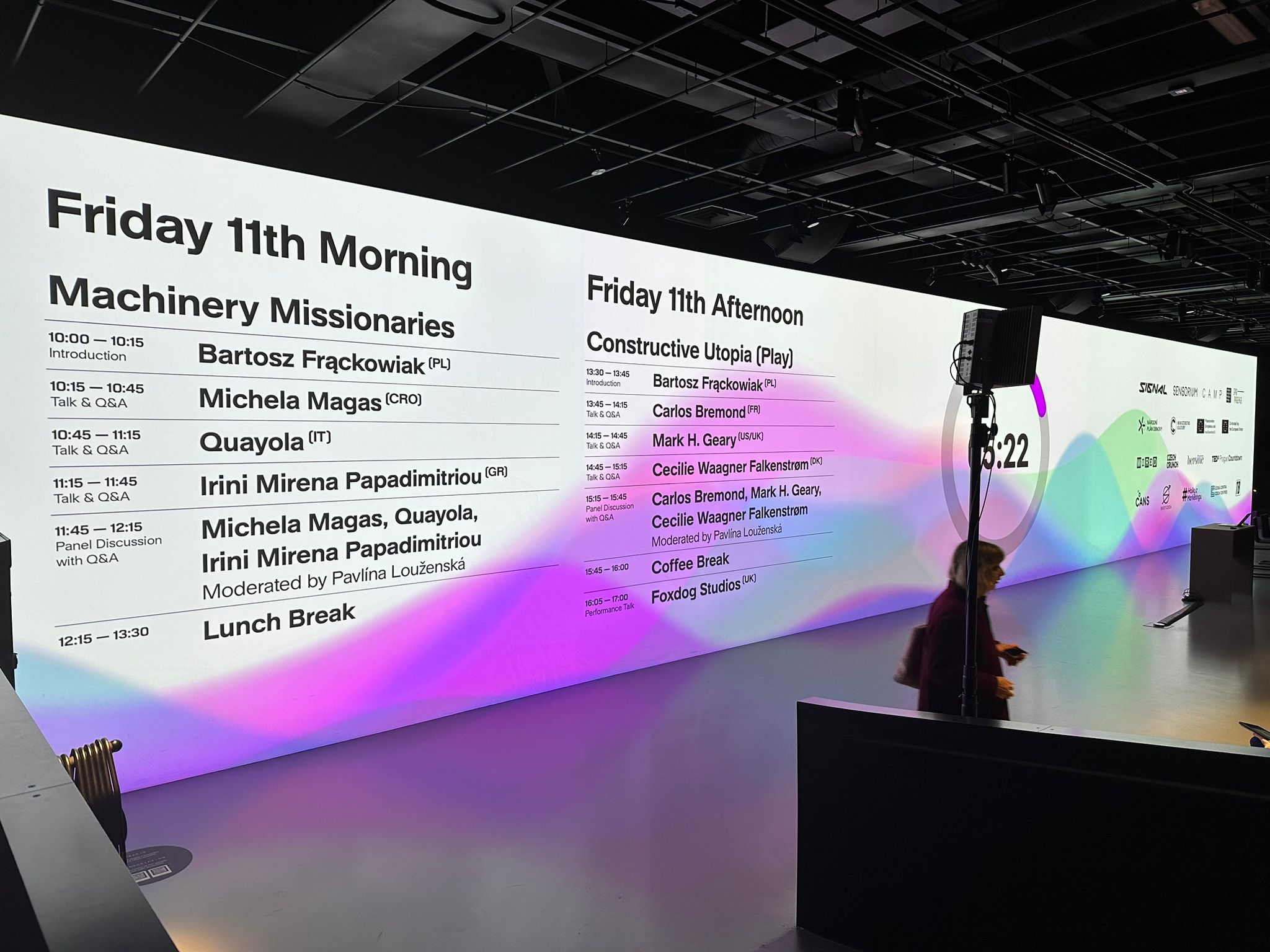
The text is one of four speeches by Bartosz Frąckowiak introducing the subsequent discussion blocks during Signal Forum in Prague in 2024.
Play can put us in a state of flow – that condition in which we allow ourselves to become completely immersed in an activity, lose track of time, and effortlessly discover next steps, gestures, solutions, as in a good and exciting dance. This state of optimal experience enables full presence and concentration without frustration. In flow, we possess a sense of complete control over our actions even while acting intuitively. Play thus becomes a source of profound fulfillment and satisfaction, allowing us to transcend our own mental, imaginative, cognitive, and physical limitations.
Play takes many forms. It can be entertainment, offering respite from over-absorption in reality, but it can also sharpen the senses and refresh perception, allowing us to see familiar situations in new light. In playful oblivion, elements of reality previously hidden may be revealed. Play possesses both creative and critical power. On one hand, it helps us perceive connections between seemingly distant phenomena, generating new ideas, perverse concepts, and out-of-the-box solutions—becoming the mechanics of worldbuilding, of producing new relationships, states, and entities. On the other hand, as in carnival, it undermines the status quo, carries out semiotic rebellion, reverses the order of the world, shatters established hierarchies, and dethrones authorities. Play holds revolutionary power, the power of social and semantic revolt.
Play can be structured wherever rules or operating procedures have been formulated. Yet it also takes unstructured forms—free improvisation without strict guidelines, allowing resistance to social rules or exploration of new possibilities. Exploratory play invites us to discover social structures, spiritual spaces, and natural environments across physical, imaginary, and virtual realms.
I propose thinking of play as an ally in designing better futures – ecosystemic futures that extend play to more-than-humans, machines, plants, animals, habitats, entire ecosystems. A play that uses the potential of speculation, transgression, constructivism, and the challenging of meanings, hierarchies, and authorities to weave the world anew into decentralized more-than-human networks. Artistic proof that this is possible comes from Špela Petrič’s work PL’AI, demonstrating that a cucumber can play with a neural network in an unsupervised human environment, entering into feedback loops devoid of goal-oriented tropism. Play becomes an ontological condition of bodies without top-down rules. The plant body and the robotic system equipped with a neural network transcend their boundaries, interact sensitively, remain attentive to each other.
This brings me to James Bridle’s concept of “planetary intelligence” – a broadening of intelligence to include decentralized, non-binary forms: the intelligences of plants, animals, ecosystems, and entire planetary systems. Bridle suggests AI could open our sensitivity and perception to these other minds. Rather than competing with or imitating human intelligence, AI might serve as a tool helping us connect with forms of intelligence that have existed for millennia but have been overlooked or misunderstood. By thinking of AI as a medium for exploring these other intelligences, we shift from human-centered control toward a more holistic, planetary perspective. What would it mean for AI to help us perceive the intelligence of a forest, an ocean, a coral reef? How might this expanded sense of intelligence transform our relationship with the natural world and with each other?
Yet as we intertwine technology, play, and futures, we must also consider dark play – a concept formulated by Richard Schechner, founder of performance studies. Unlike conventional play where all participants know the rules and boundaries, dark play is characterized by ambiguity, unpredictability, and hidden dynamics. Some players may not realize they are involved in a game; rules, if they exist, are often known only to a few. This creates scenarios that blur lines between reality and fiction, play and seriousness, safety and danger.
These categories surprisingly resonate with the VUCA framework – volatility, uncertainty, complexity, ambiguity – which we use to describe our current world and often cite as justification for structured futures research and design. By analogy, we might venture that our world increasingly resembles a state of perpetual dark play. Dark play thrives on ambiguity of roles, rules, and intentions, leading participants to question what is real and what is artificial, what is consensual and what is coerced. It becomes not merely entertainment but a potent tool for critiquing social norms, challenging power dynamics, and unsettling our sense of control.
Consider contemporary AI systems: would we be willing to sell our souls – our private data – to a modern Mephistopheles hiding behind an extremely helpful interface? Will next-generation AI prove to be products of Frankenstein, and will we be the Modern Prometheus? Will we lose control of artificial general intelligence as prophets of AI doom warn, or are these unconscious-derived fears that will never materialize? Will AGI play its dark game with us?
These questions point toward a broader inquiry: in what ways does technology enhance, amplify, or change the dynamics of play, especially as it relates to the creation of new realities and worlds? Technology can mediate exchanges between nature and humans in both directions, with potential to enrich our innate connection to the natural world rather than sever it. It can challenge the perception that humans and nature are inherently in opposition.
The spectrum of play thus extends from constructive utopia to dark subversion, from structured games to free improvisation, from human-centered entertainment to more-than-human collaboration. In navigating this spectrum lies our capacity to imagine and design futures that transcend the limitations we have imposed upon ourselves and our planetary cohabitants.