
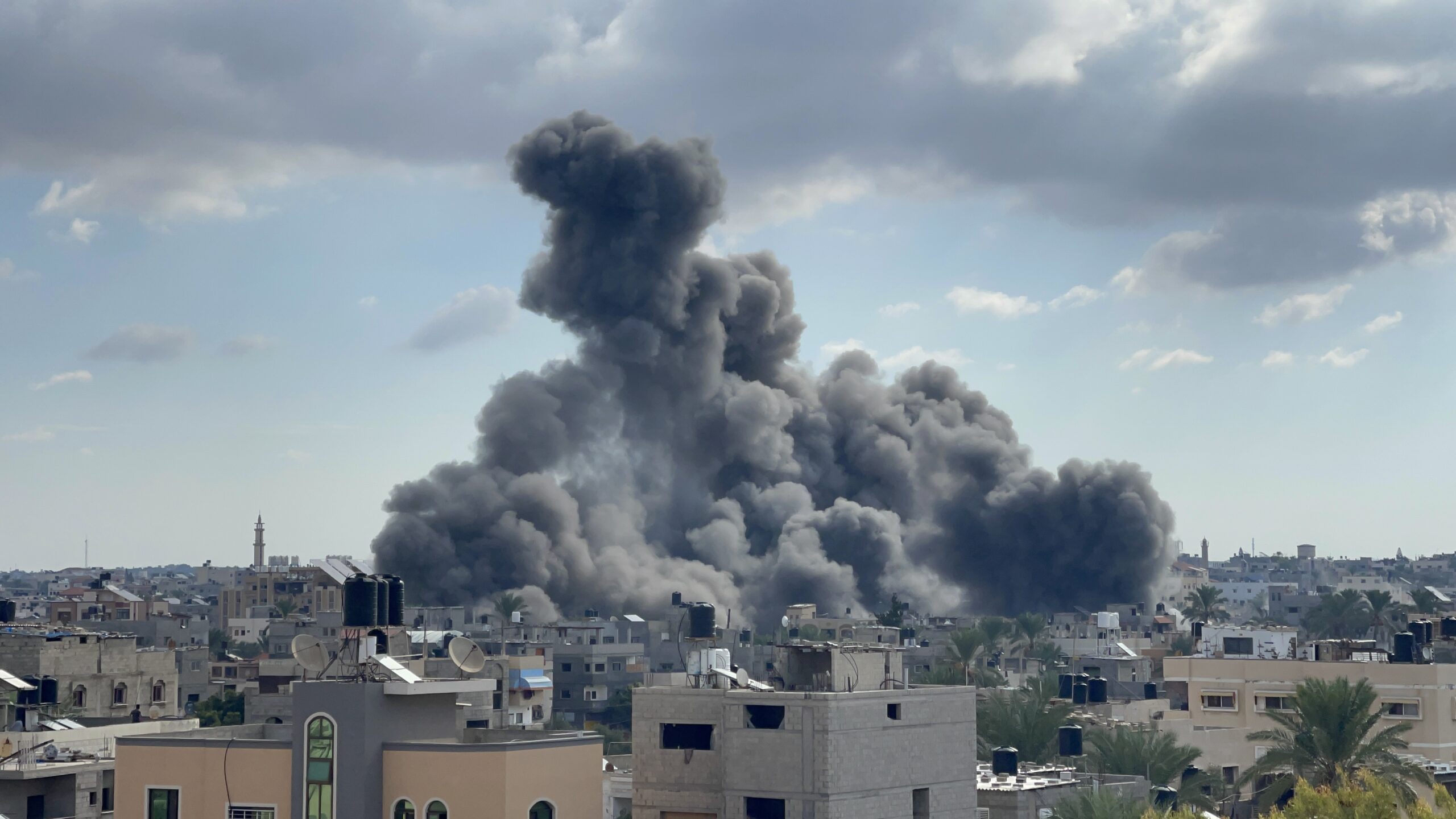
The Invisible ConflictEmissions is part of our ongoing emerging issues identification practice at Strategic Dreamers. We track signals at the intersection of technology, governance, and security that have yet to enter mainstream strategic discourse.
Description
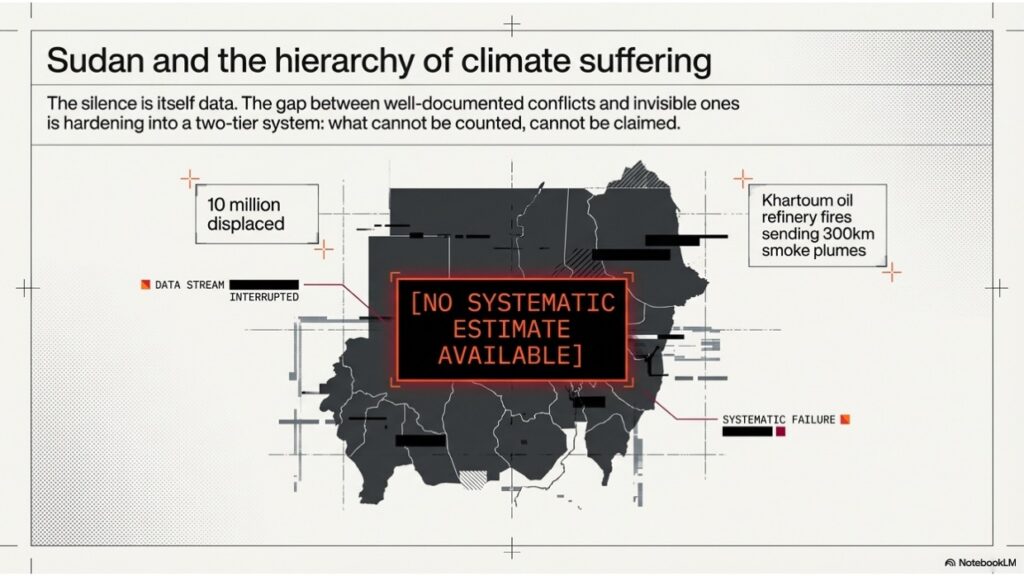
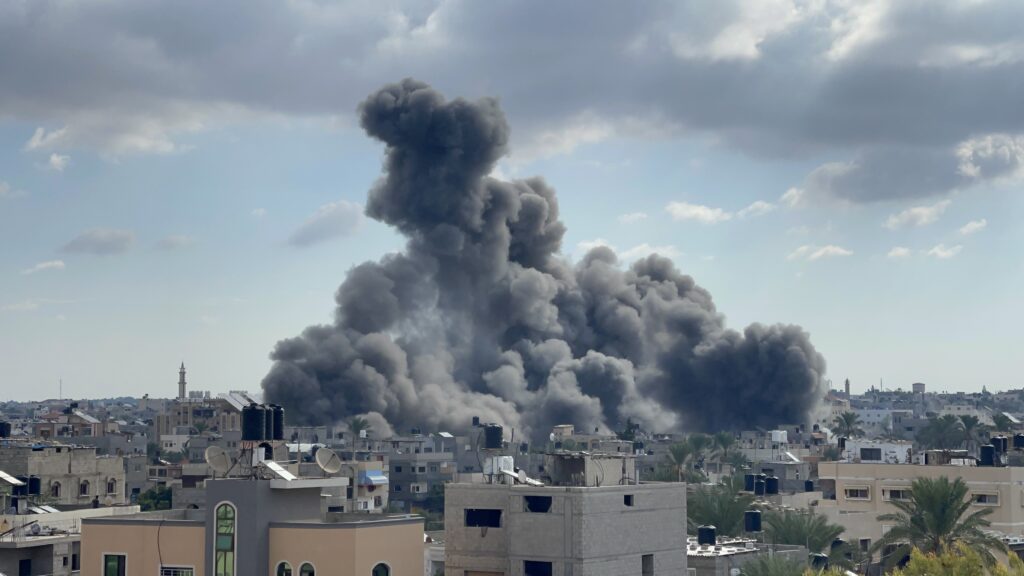
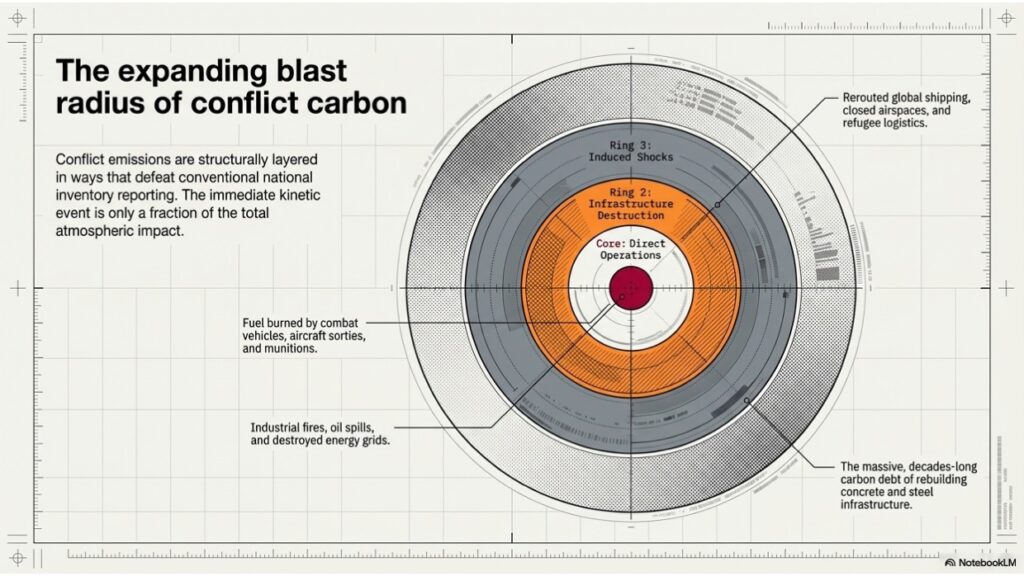
War has become a hidden engine of the climate crisis. It burns through cities, fuel depots, supply chains, and futures, releasing emissions on a scale comparable to civilian aviation and shipping combined — yet it still slips through the ledgers of global accountability. From the oil fires of Tehran to the ruins and reconstruction of Gaza, from Ukraine’s vast carbon burden to Sudan’s near-total atmospheric silence, modern conflict leaves not one plume but many: from combat, destruction, displacement, rerouted trade, and the long afterlife of rebuilding. The means to count these emissions now exist. What does not yet exist is a political order willing to see them clearly. In the widening gap between measurement and recognition, between evidence and institution, the climate politics of war is already being written.

Why it matters
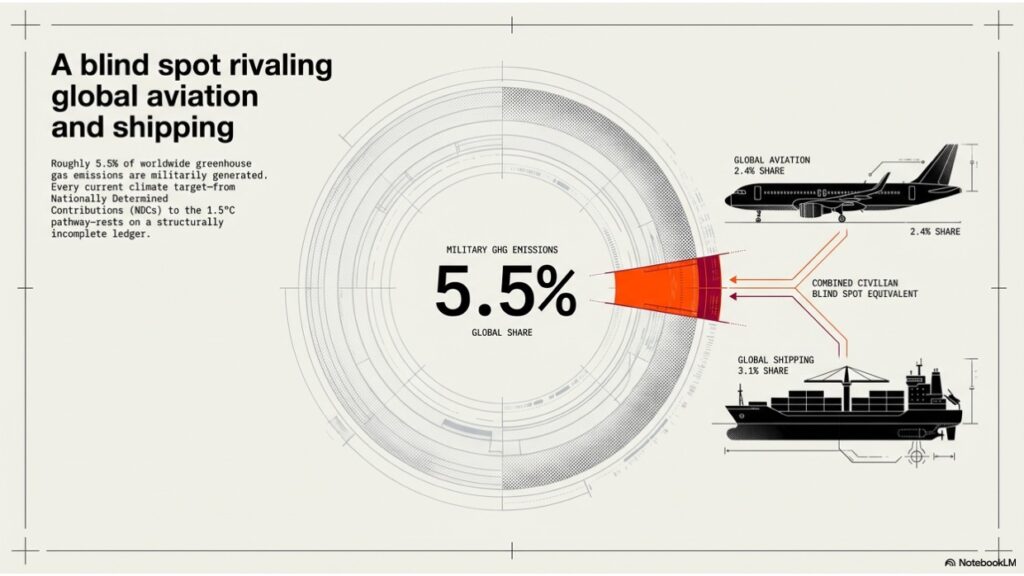
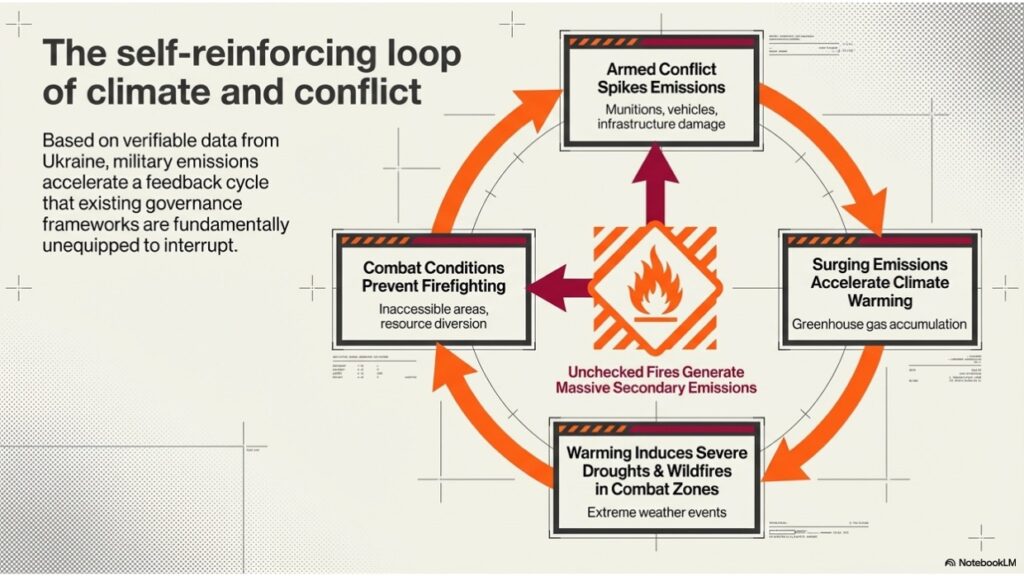
If something like 5.5% of global emissions is produced by military activity yet never fully enters the official ledger, then every climate target is shadowed by omission. What appears as a gap in accounting is, in fact, a deeper failure of political imagination. War does not simply add emissions to the atmosphere; it sets in motion a recursive logic in which conflict fuels carbon release, carbon destabilises climate, climate disruption intensifies drought, fire, and scarcity in already fragile zones, and those conditions in turn generate further violence and further emissions. The result is not a one-off discrepancy but a compounding distortion. A climate regime that cannot see this loop cannot truly govern it, and any promise of emissions reduction made without it remains, at least in part, a fiction.
What’s strange about it
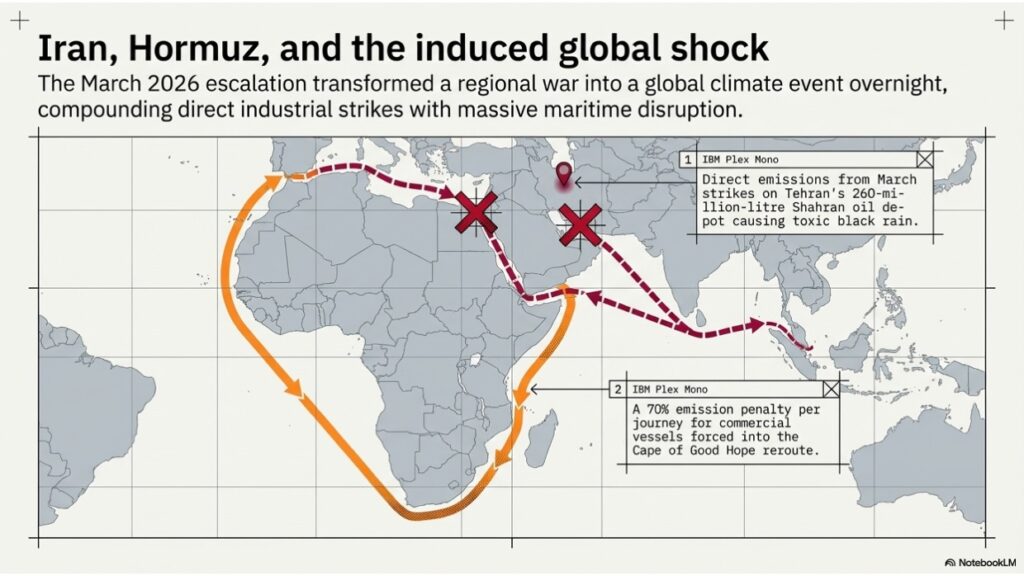
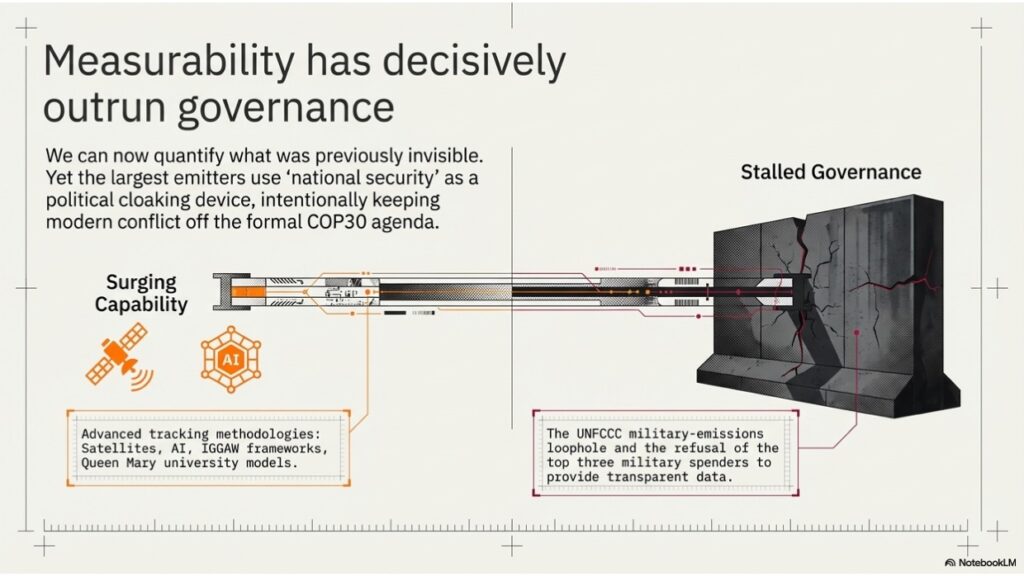
The paradox is that our capacity to measure has already surpassed our capacity to govern. What once remained invisible can now be quantified with increasing precision, yet the world’s three largest military spenders — the United States, China, and Russia — still do not transparently report military emissions to the UNFCCC, while conflict emissions remain absent from the formal agenda of COP30. In practice, the language of “national security” operates as a political cloak, shielding from scrutiny what is, in sheer volume, a major category of emissions. Most people fail to see this, not because the evidence is missing, but because war is still narrated as a matter of security or humanitarian crisis, never as a climate event — even when oil is burning in the streets of a city of fourteen million.
Implications at peak maturity
The following are speculative, hypothetical consequences — not predictions or facts. They illustrate what could happen if this emerging issue reaches full maturity and institutional traction.
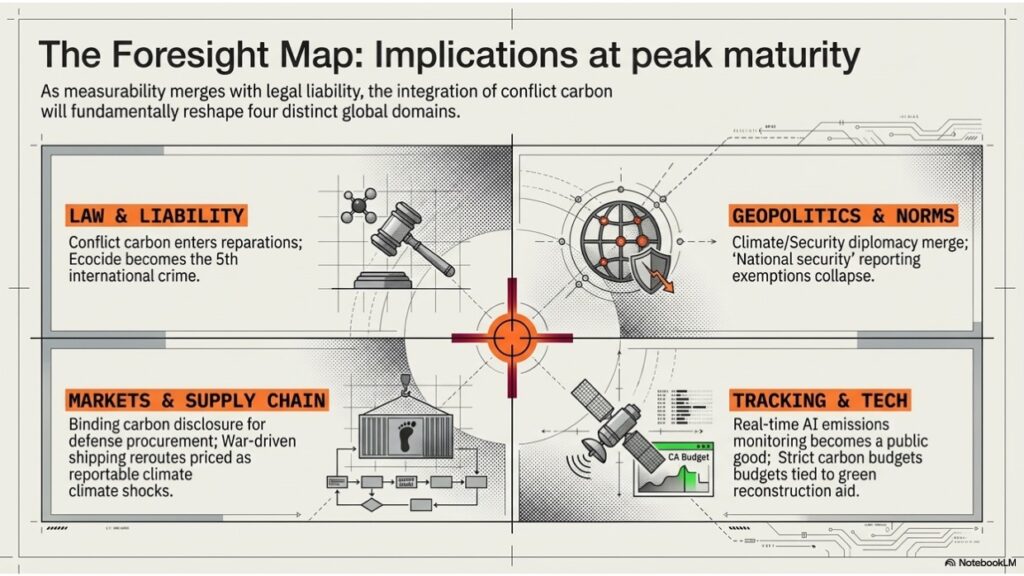
1. Mandatory military emissions reporting enters COP negotiations. At least one bloc (EU, Pacific Islands) forces disaggregated military emissions into NDC templates. Major powers resist but the norm is established.
2. Conflict carbon liability enters reparations law. Following the Ukraine precedent, post-conflict settlements routinely include climate compensation claims. Insurance and sovereign debt markets begin pricing war-related carbon exposure.
3. Real-time conflict emissions monitoring becomes a standard public good. Satellite-based, AI-driven attribution systems make concealment technically impossible, enabling NGOs, journalists, and courts to produce emissions estimates within days of strikes.
4. The “national security” emissions exemption collapses. Military emissions are integrated into global carbon budgets. The geopolitical order splits between states that accept carbon accountability for their armed forces and those that refuse — creating a new axis of climate diplomacy.
5. Climate diplomacy and security diplomacy merge into a single field. Ceasefire negotiations begin to include emissions clauses. Military alliances adopt internal carbon budgets. The concept of “climate security” shifts from metaphor to operational doctrine with enforceable metrics.
Source
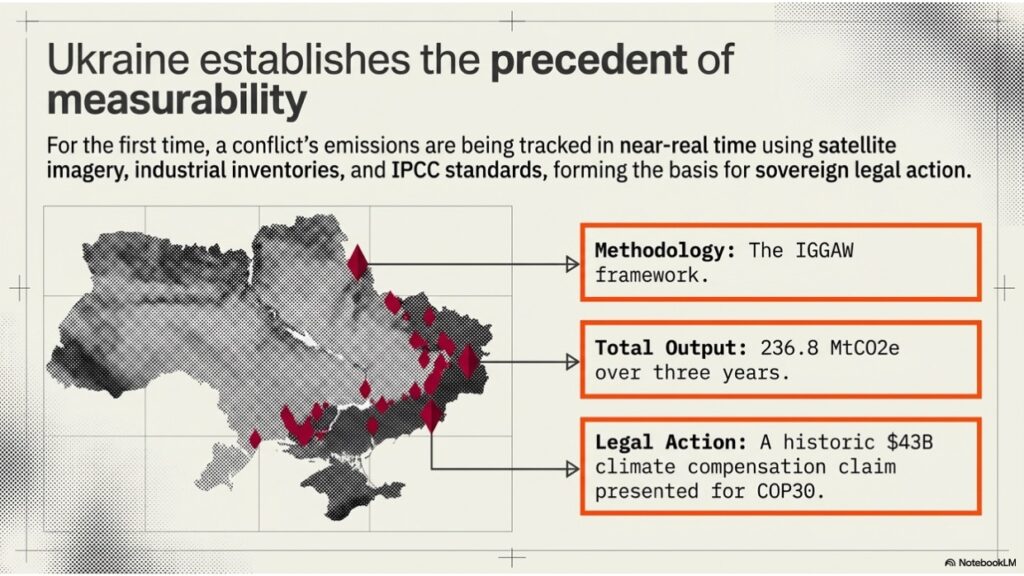
- de Klerk, Lennard et al. Climate Damage Caused by Russia’s War in Ukraine: 24 February 2022 – 23 February 2025. Initiative on GHG Accounting of War / Ecoaction, October 2025.
- This is the key source for the estimate of 236.8 MtCO₂e over the first three years of the war.
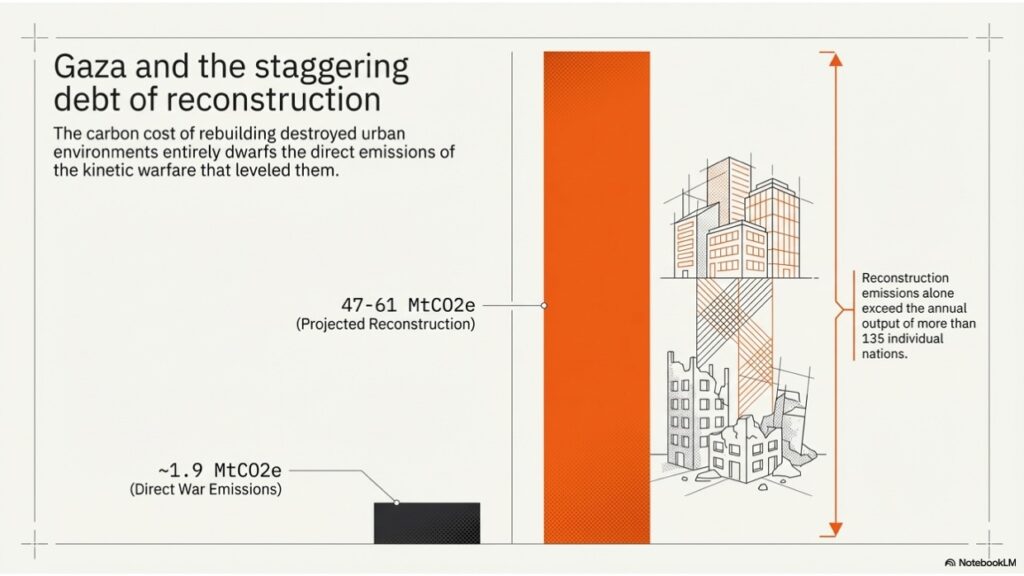
- Neimark, Benjamin; Bigger, Patrick; Otu-Larbi, Frederick; Larbi, Reuben. A Multitemporal Snapshot of Greenhouse Gas Emissions from the Israel-Gaza Conflict.
- SSRN, 2024. DOI: 10.2139/ssrn.4684768. This is the early Gaza emissions preprint most often cited in discussions of conflict-related carbon accounting.
- Neimark, Benjamin et al. War on the Climate: A Multitemporal Study of Greenhouse Gas Emissions of the Israel-Gaza Conflict.
- SSRN, 2025. DOI: 10.2139/ssrn.5274707. This is the later and more comprehensive Gaza study, including wider temporal scope and reconstruction-related emissions.
- Alexander, Grace. New Data Reveals the Military Emissions Gap Is Growing Wider. Conflict and Environment Observatory (CEOBS), 6 November 2025.
- Useful for the argument that military emissions reporting to the UNFCCC remains incomplete and is deteriorating.
- Kinney, Ellie. Climate and Militaries Policy Briefing Note 2/25: Accounting for the Uncounted. CEOBS, November 2025.
- A concise policy-oriented source on why conflict and military emissions remain undercounted in climate governance.
- Stockholm International Peace Research Institute (SIPRI). Military Expenditure Database.
- The core database for global military spending time series.