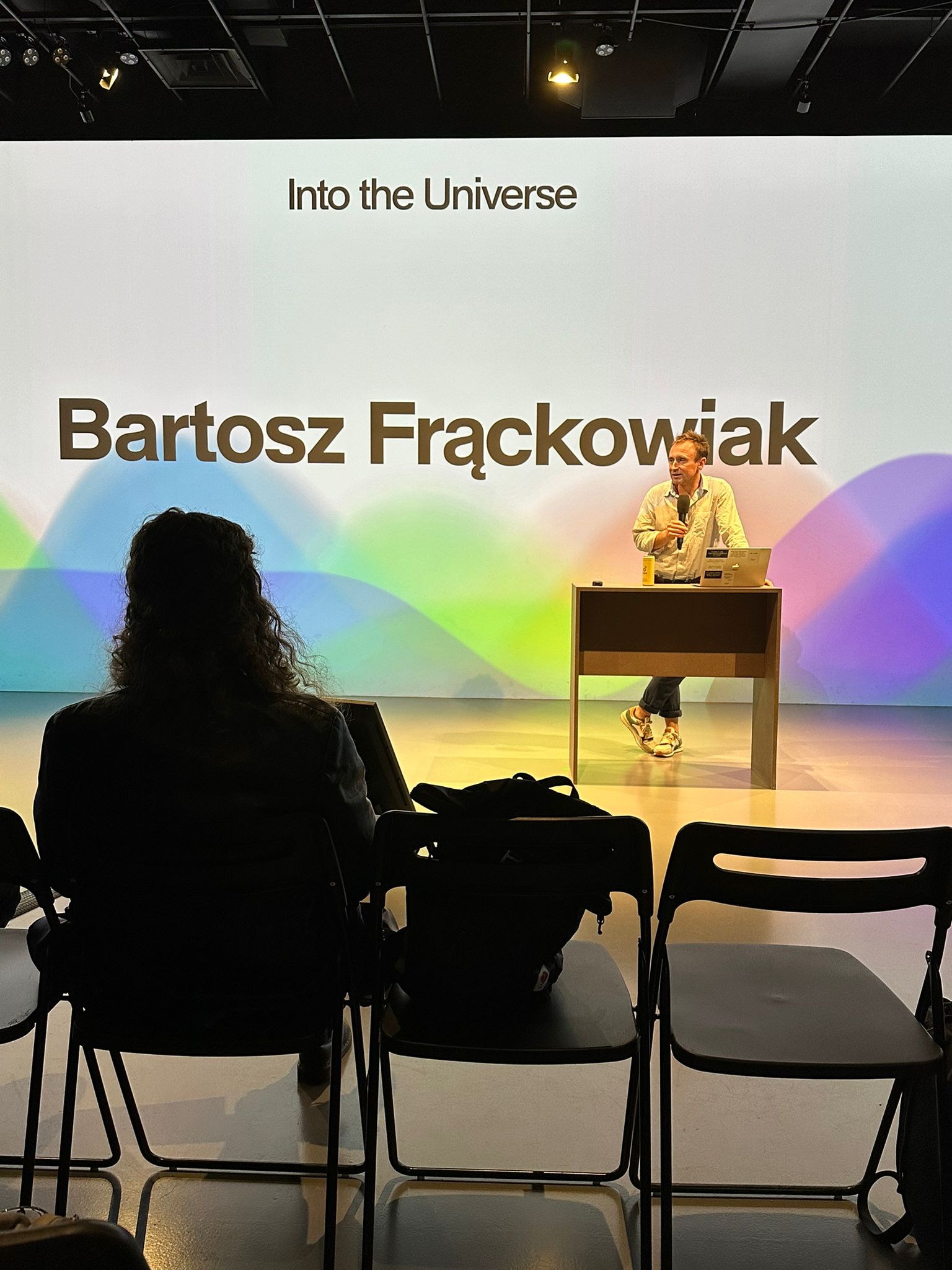
The text is one of four speeches by Bartosz Frąckowiak introducing the subsequent discussion blocks during Signal Forum in Prague in 2024.
The cosmos has always been a mirror of human imagination. But today, more than ever, it has become an arena where two fundamentally different visions of the future collide.
Gravitational Waves and Fluid Reality
On September 14, 2015, scientists from the LIGO project made a groundbreaking discovery — they detected gravitational waves. This event confirmed Einstein’s predictions from the theory of relativity, but more importantly, it forced us to radically rethink the nature of the universe.
It turns out that spacetime is not a static stage on which cosmic events unfold. It is fluid, dynamic — stretching and compressing like the surface of a pond after a stone is thrown in. When black holes collide, they send ripples through the universe that literally distort the structure of reality.
This discovery can serve as an invitation to build new visions of the future based on entirely different models of the world.
Two Paths — Two Cosmoses
The paradox of contemporary space exploration lies in the fact that despite possessing knowledge of such a radically different nature of reality, we often reproduce in space the same patterns that have driven exploitation and power dynamics on Earth for centuries.
The first path sees the cosmos as a space for radical speculation. A place that invites us to invent prototypes adequate to entirely different physical conditions — different gravity, chemical composition, landscapes, experiences of space and time. An opportunity to build a better world based on different values and laws.
The second path sees the cosmos as a mirror of earthly power relations. New colonial fantasies born of greed and the lust for conquest. A race for resources and new extractivism. It is no coincidence that discussions about the future of mining are most alive precisely in the context of space and the deep ocean.
The Privatization of the Sky
In recent years, space exploration has moved beyond the domain of governmental agencies. SpaceX, Blue Origin, Rocket Lab — private enterprises are shaping a new phase of cosmic conquest. Reusable rockets, space tourism, plans to extract resources from asteroids.
These ventures raise fundamental ethical questions: Who owns extraterrestrial resources? What principles should govern the exploitation of celestial bodies? Who sets the rules of the game in a space that theoretically belongs to everyone?
Cosmic Redesign of Possibilities
Yet there is a third way – examples of research that show how space can stretch our imagination in unexpected directions.
The European Space Agency’s parastronaut program is a breakthrough. The ICAres-1 mission, conducted at the LunAres habitat in Poland, tested how individuals with disabilities function under simulated space mission conditions. The results proved fascinating – not only in terms of designing accessible habitats, but above all in discovering that some disabilities can become particularly valuable abilities in space conditions.
This is an excellent example of radical reframing — a situation where what we perceive as a limitation on Earth may prove to be an asset under different physical conditions.
Into the Universe — But Which One?
We stand at a crossroads. From the tension between these visions, new economic, political, ecological, and social paradigms will emerge. They will shape not only our perception of the cosmos but also how we organize our coexistence — among ourselves as humans and with other planetary systems.
Space can become a realm for the realization of dreams and hopes, for designing better worlds. Or a place where current global trends are reinforced and conflicts amplified.
Gravitational waves have shown us that the very structure of reality is fluid and susceptible to change. Perhaps this is the best metaphor for the moment we find ourselves in — everything is still in motion, nothing has been finally shaped.
If we don’t lose this opportunity.