Emerging Cases — Seeds of the Futures
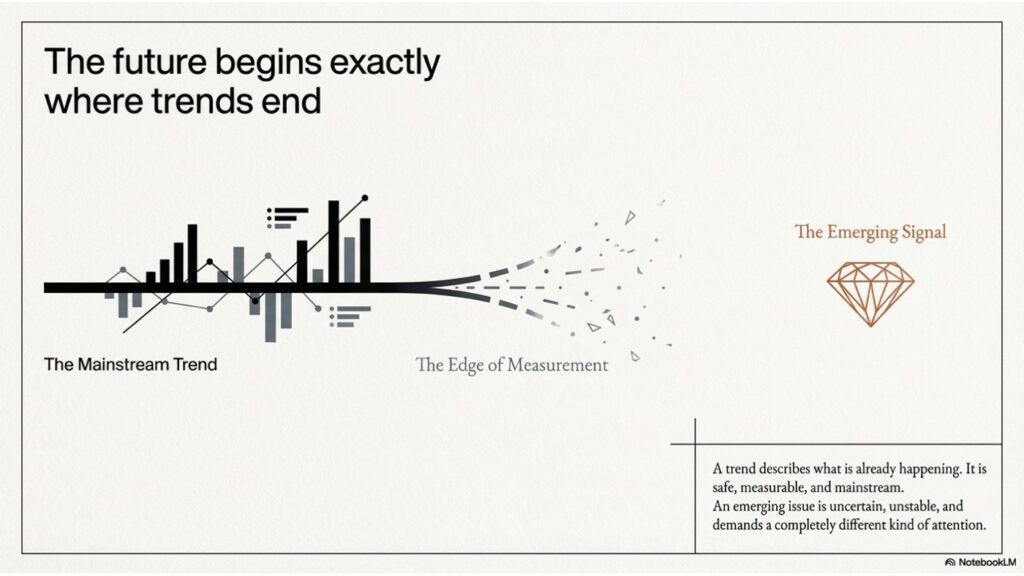
Futures begin where trends end
There is a surplus of information about the future — forecasts, projections, scenarios produced in ever-increasing volume. And a scarcity of imagination — the ability to perceive what is genuinely new, what does not fit existing categories, what refuses to confirm what we already believe.
Emerging Cases is a publication programme that works in the gap between these two conditions. Every two weeks, we publish one emerging case: a signal of change detected, interpreted, and translated into the language of strategic utility. Each text is an attempt to grapple with something still forming — material that is uncertain, unstable, and demanding of interpretation, but valuable precisely for those reasons.
What an emerging case is — and isn’t
An emerging case is not a trend in the conventional sense. A trend describes what is already happening — it has data, trajectories, metrics. An emerging case is something that demands a different kind of attention. It can take several forms:
Sometimes it is a phenomenon that precedes any trend — a practice, hypothesis, experiment, or configuration that has not yet entered mainstream awareness but carries the potential to change the rules of the game. Something genuinely new, visible only at the right angle.
Sometimes it is a known development read through a new lens. The data may already exist — an early trend, a familiar technology, a documented shift — but no one has yet interpreted it in a way that reveals its deeper strategic significance. The signal is not new; the interpretation is. A reframing that transforms background noise into a question worth pursuing.
And sometimes it is a convergence — the moment when several apparently unrelated phenomena, each unremarkable on its own, begin to form a pattern that points to a deeper systemic shift. A regulatory micro-change, a grassroots experiment, and a scientific preprint that individually are curiosities but together indicate that something structural is reorganising. Detecting such configurations is the art of sensemaking — and the hardest form of signal work to automate.
We call each entry a “first crystallisation” — the moment when, from a supersaturated solution, structure begins to emerge. Not yet complete, not yet robust, but already acquiring form. Worth watching, because it may be the seed-crystal of a new order.
Why this isn’t another trend list
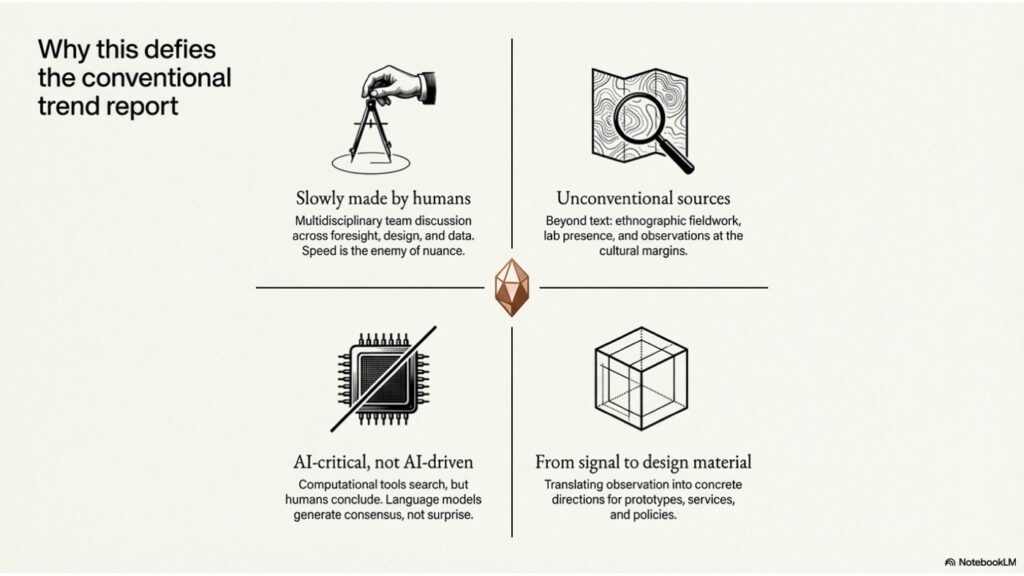
Slowly made by humans. Every emerging case passes through multiple rounds of multidisciplinary team discussion — foresight, anthropology, design, data analytics, curatorial practice, political science, semiotics. Speed is the enemy of nuance, and nuance separates a genuine signal from a recycled talking point.
Sources most scanning never reaches. We combine scientific preprints and data analysis with ethnographic fieldwork, artistic practice, grassroots experiments, and physical presence in laboratories, conferences, and cultural margins. Many signals don’t exist in textual form — they exist in practices, spaces, and behaviours.
AI-critical, not AI-driven. We use computational tools to search the information space, but never to formulate conclusions. Language models generate consensus, not surprise — and emerging issues, by definition, are phenomena underrepresented in training data.
From signal to design material. Each text doesn’t stop at observation. It translates the signal into strategic questions, implications for specific actors, and a “design space” — concrete directions for prototypes, services, policies, or new competences. The goal is to convert observation into creation.
What you get
First Crystallisations — the biweekly text series
Every two weeks, one emerging case — detected, interpreted, and translated into the language of strategic utility. Each entry follows a consistent architecture:
Description. A dense, narrative account of the signal: what it is, where it appeared, what makes it significant.
Why it matters. Systemic significance: what feedback loops, structural gaps, or compounding dynamics does this signal reveal? What does it mean for the systems we take for granted — governance, markets, institutions, infrastructures?
What’s strange about it. The paradox, the tension, the thing that doesn’t fit the dominant narrative. Every genuine emerging case contains something that resists easy categorisation — a mismatch between what we can now measure and what we are willing to govern, between what is technically possible and what is politically legible. This section names it.
Implications at peak maturity. Speculative, hypothetical consequences — not predictions but grounded “what ifs.” What could happen if this signal reaches full maturity and institutional traction? Each implication is a scenario fragment: concrete enough to take into a strategy meeting, speculative enough to stretch assumptions.
Sources. Annotated references — not a flat bibliography but a curated set of sources with commentary explaining what each contributes and why it matters.
Pre:Fact — our methodology
Our approach to working with emerging cases rests on four interlocking layers: human expert intelligence (multidisciplinary, slow, iterative), ethnography and field presence, foresight sensemaking tools (Futures Wheel, Causal Layered Analysis, implication mapping), and computational foresight used critically and cautiously. None is sufficient alone; together they form a system for detecting, interpreting, and translating signals.
Who this is for
Strategy teams and leadership that want to see what’s forming before it becomes consensus. Foresight practitioners looking for fresh material beyond recycled trend reports. Innovation functions searching for breakthrough directions. Policy-makers and regulators who need early warning on emerging systemic issues. Anyone who believes the future crystallises in many places simultaneously — and that the ability to look in non-obvious directions is as valuable as advanced analytics.
Published Emerging Cases
The series is live and growing. Below you will find all published entries — each a self-contained emerging case, ready to read, share, and use as material for strategic thinking. New crystallisations appear every two weeks.