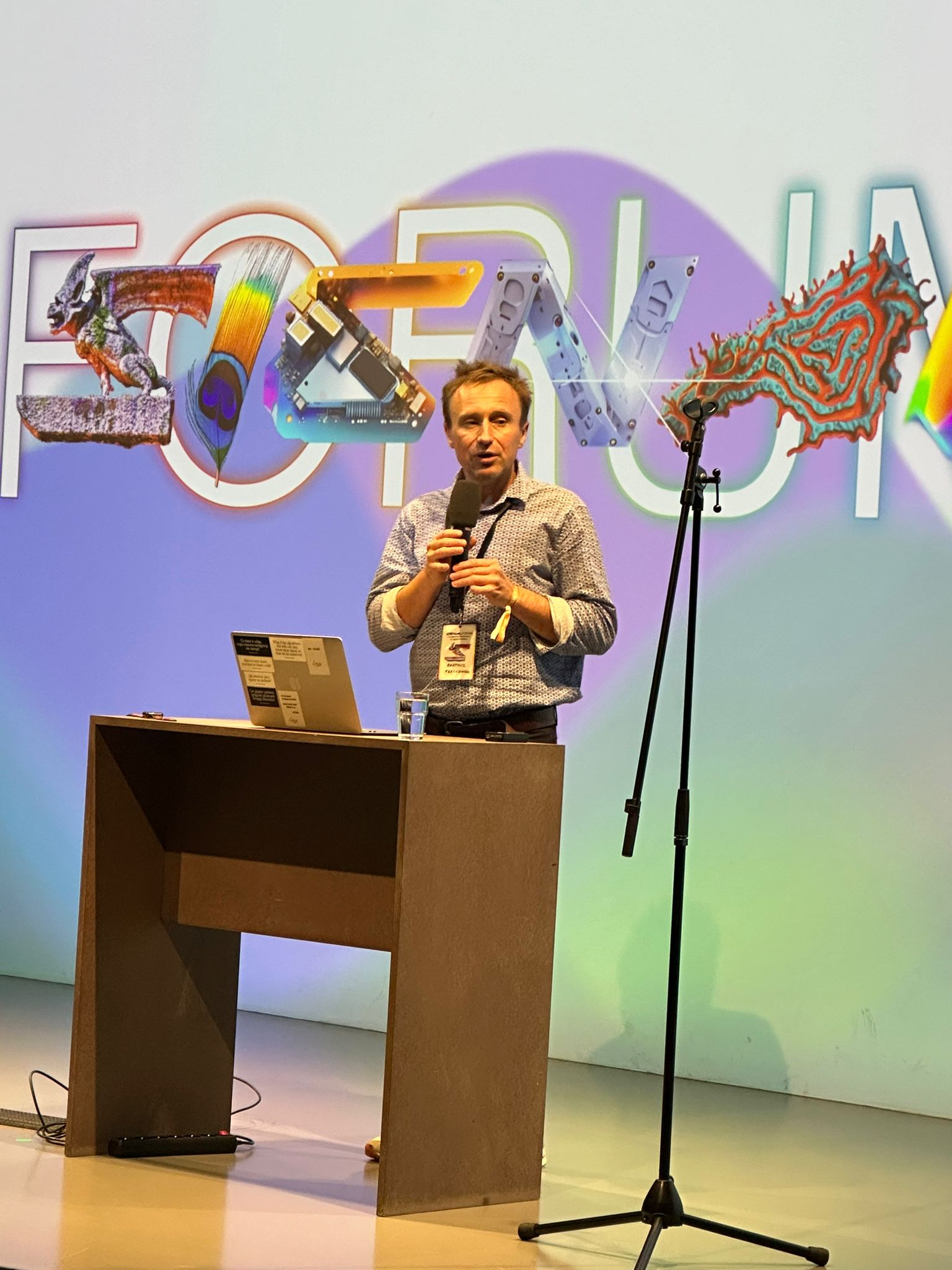
The text is one of four speeches by Bartosz Frąckowiak introducing the subsequent discussion blocks during Signal Forum in Prague in 2024.
Travel has often been a narrative of conquest: of land, space, oceans, and now, increasingly, of time and data. Discovery in order to exploit and extract.
When we think of travel, we often imagine crossing spaces: oceans, skies, or perhaps even venturing into outer space. But there is another kind of journey — one that does not concern itself with the cliché of movement toward the distant horizon. This is not a call to cross geographical borders or to break through physical barriers. Not first and foremost.
Instead, it turns our gaze inward and downward, and between the spaces that escape the eye — to the microcosmic, exploring the fabric of our planet through the metaphorical and literal lens of travel into the Earth itself: visiting the depths beneath our feet, the materials that constitute our world, and the interconnected systems with their timescapes.
Timescapes
The term timescape was popularized by sociologist Barbara Adam in her 1998 book Timescapes of Modernity. Rather than viewing time as a simple, linear progression, the concept suggests that time is multi-dimensional and experienced in different ways depending on context, scale, and perspective.
Just as landscapes have various elements — hills, rivers, forests — timescapes consist of different layers and scales of time. Human life operates on a biological timescale, whereas environmental processes, such as the formation of geological structures or the evolution of ecosystems, usually unfold over millennia. These multiple temporal dimensions overlap and interact. In a timescape, time is not seen as a steady, uniform flow but as shaped by rhythms and patterns: the daily cycle of work and rest, the seasonal changes of nature, the long-term cycles of innovation and technological obsolescence.
Timescapes highlight that time is experienced relationally. Our perception of time is influenced by our interactions with other people, objects, environments, and technologies. What, then, are the timescapes of soil, of materials, of different interconnected systems?
Reading the World
Our imagination has long been captivated by the idea of traveling into the Earth, most famously in Journey to the Center of the Earth by Jules Verne. Verne’s tale is not just a story about a subterranean voyage, but about confronting the unknown, crossing boundaries that are both physical and imaginative, and encountering deep time — layers of history embedded in the planet.
The deep traveler is, therefore, not one who simply moves downward but one who reads the world: deciphering signs, interpreting layers, and tracing meanings that escape the casual observer. Just as Verne’s characters descend into volcanic tubes, we too can descend today — not into caverns and magma, but into the rich complexity of soil, materials, and the living systems they host.
Such a shift in perspective allows us to recalibrate our futures-oriented imagination, to open up to the unexpected, the surprising, the puzzling, the non-obvious. This kind of journey tunes up our sensibilities, makes us abandon routine cognitive patterns and naturalized habits, so that we keep learning to look anew, adjusting our gaze to different dimensions, scales, and timescapes. This shift in perception and the discovery of various timescapes takes place through deep listening.
What can the Earth — soil, materials, systems — tell us if we listen carefully?
The Hidden Audiosphere of Soil
The work of artist Saša Spačal challenges us to listen to the subdued and hidden audiosphere of the soil. The soil is not mere earth or substrate; it is a living network of interactions, a vibrant ecosystem composed of countless microbial and fungal relationships. Spačal guides us through the layers of this underworld, where symbiotic relationships between organisms emerge, exist, and evolve.
By sonifying this subterranean world, she amplifies its signals to reveal that even the dirt beneath our feet has its own vibrant social network. In Anatomy of Symbiosis, we hear the audio artifact of the disintegrating symbiotic bond between soil bacteria Rhizobium trifolii and red clover Trifolium pratense — a bond broken by human intervention through the introduction of nitrogen fertilizer. In Terra Xenobiotica, a chromatogram of contaminated soil from airfield sites is transformed into sound.
But this exploration is not just about biology. It is about care. What does it mean to nurture these ecosystems in a world that often neglects the microscopic — processes happening on small scales?
When we change scale and take a journey into the soil, the way we experience time also changes. Soil holds the memory of species’ past and the potential of future life. It pushes us to reconsider the human relationship with the Earth, not as conquerors, but as participants in a grander symbiotic process.
The Language of Materials
Seetal Solanki works as a materials translator – a concept that may sound unusual at first. Yet materials, much like people, have stories and languages. They traverse time and space, being shaped by geological processes, human hands, and the passage of history. The materials we touch are entangled with histories far beyond our immediate perception, whether it is the copper mined from an ancient volcanic deposit or the plastic made from fossil fuels buried for millions of years.
Solanki’s practice involves uncovering material identities, then examining their lifecycles: where do the raw materials come from, what are the social and cultural histories of their extraction, how do their decomposition processes take place, and how could they be used in new ways or reused. Finally, she asks about application.
Everything we interact with, from the steel in our buildings to the fabrics on our bodies, has a journey, a path that it has traveled to become what it is. Materials migrate, much like people. They move across continents, they are shaped by cultures, and they carry with them histories that often go unrecognized.
How can we learn to “speak” the language of materials? How can we trace their origins, their transformations, and their touch points across time? In understanding these stories, we may not only reconnect with the material world around us but also learn to engage with it more responsibly, sustainably, and thoughtfully. Deep travel, in this sense, is not just a metaphor but a practice — one that bridges science, design, and cultural storytelling.
In one interview, Solanki outlined the relationship between her three-phase concept of working with materials and three different temporal horizons: “This three-pronged approach sees us changing the way we use language around materials (which affects the immediate future), informing ourselves of behavioral change (informing the near future) and ultimately altering the systems used to turn materials into things (which looks deep into the future).”
This raises a compelling question: shouldn’t we start talking about futures scenarios with exactly what the future is made of — materials?
Systems and Their Fragilities
A different kind of deep journey leads into the systems that shape and organize the world we live in. Georgina Voss, in her book Systems Ultra: Making Sense of Technology in a Complex World (Verso, 2024), examines the invisible but omnipresent systems that govern everything from global trade to air traffic control, from architectural design to car crash testing.
Voss explores how these systems shape our experience of time, space, and matter, while also revealing their inherent fragility — the “breakages” and “deviances” that disrupt their smooth operation. Her work takes us into the concept of time itself. She focuses on what she calls the “ship in a bottle episode” — a phenomenon in film and television where the narrative becomes contained in a specific, enclosed space, freezing time for that story, even as the outside world continues on. Systems, too, can create such temporal enclosures, zones where time operates according to different rules.
Multiple Scales
Bringing these threads together, we realize that deep travel is about exploring the multiple scales at which life, matter, and time operate. It requires us to descend – into soil, into materials, into systems – and to listen. The deep traveler does not conquer new territories but learns to read the layered complexity of what already exists, discovering timescapes that have always been present yet have escaped attention.
The journey begins wherever we stand.