Futures Leadership
A leadership development program for those who lead with the future — not just toward it.
The most consequential choices leaders face are not about what is happening now. They are about what is becoming possible, what is quietly disappearing, and what has not yet been named. Yet most leadership models treat the future as a destination — something to plan for, predict, or prepare against.
We propose something different. Futures Leadership is a leadership development program in which the future is not an object of planning but a working material of leadership itself. It is a structured, practice-based journey that equips executives, founders, and strategy leaders with the competencies to sense emerging change, explore multiple possible futures, and design strategy with intention and agency. A leader who uses the future intentionally does not merely react to change — they see it before others do, imagine what it could become, and shape it through deliberate action.
This is not about supporting leaders with foresight. It is about building leadership on futures literacy — the capacity to sense, imagine, and design with what does not yet exist.
Why Short-Term Management Is Running Out of Road
For decades, business has operated on a familiar rhythm: annual plans, quarterly targets, KPIs calibrated to the next twelve months. This model still works somewhere — in stable markets, in sectors where the rules change slowly, in organizations large enough to absorb shocks through sheer inertia. But its shelf life is expiring.
We now operate in what has been described as a BANI world — an environment that is:
- Brittle: systems that appear solid can shatter without warning. Supply chains, financial instruments, political alliances, business models — what looks robust is often rigid, and rigidity breaks.
- Anxious: decision-makers face not just uncertainty but a pervasive sense that any choice could be wrong. Information overload, conflicting signals, and the speed of change produce a leadership climate saturated with anxiety.
- Non-linear: cause and effect no longer follow proportional logic. Small events can cascade into systemic disruptions; large investments can yield no result. The future does not unfold — it erupts.
- Incomprehensible: the complexity of interconnected global systems exceeds the capacity of any single leader, team, or analytical framework to fully grasp. We are making consequential decisions in a world we cannot entirely understand.
In a BANI world, short-term planning is not just insufficient — it is actively misleading. It creates the illusion of control where none exists. It rewards speed over direction, execution over judgment, and optimization of the present over preparation for what comes next.
The organizations that will thrive in the coming decade are those that develop a fundamentally different relationship with time. Not abandoning short-term execution — but grounding it in medium- and long-term awareness. Building the capacity to sense what is emerging, imagine what could unfold, and design strategies that remain coherent across multiple possible futures.
This is not a theoretical argument. It is an operational reality. And it demands a new set of leadership competencies — the ones we describe below.
The Futures Leadership Triad
Futures Leadership rests on three interconnected capacities. Together, they form a new model of what it means to lead in conditions of deep uncertainty.
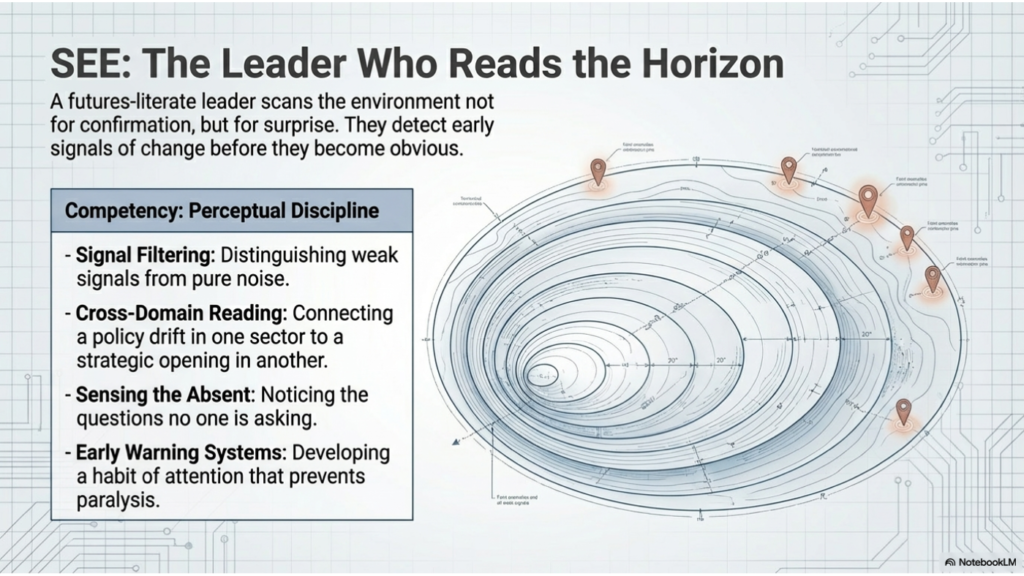
I. SEE — The Leader Who Reads the Horizon
The first capacity is perception: the ability to notice what others overlook. A futures-literate leader scans the environment not for confirmation, but for surprise. They detect early signals of change — emerging technologies, shifting values, demographic undercurrents, policy drifts, cultural tensions — before these become obvious to everyone.
What this looks like in practice:
- Recognizing weak signals and distinguishing noise from meaningful change
- Reading across domains — connecting a regulatory shift in one sector to a strategic opening in another
- Sensing what is absent: the questions no one is asking, the assumptions no one is testing
- Developing a personal and organizational early warning system — not as a tool, but as a habit of attention
The leadership competency: Perceptual discipline. The capacity to stay alert to emerging realities without becoming overwhelmed or paralyzed. Holding a wide field of vision while maintaining strategic focus.
II. IMAGINE — The Leader Who Explores Possible Worlds
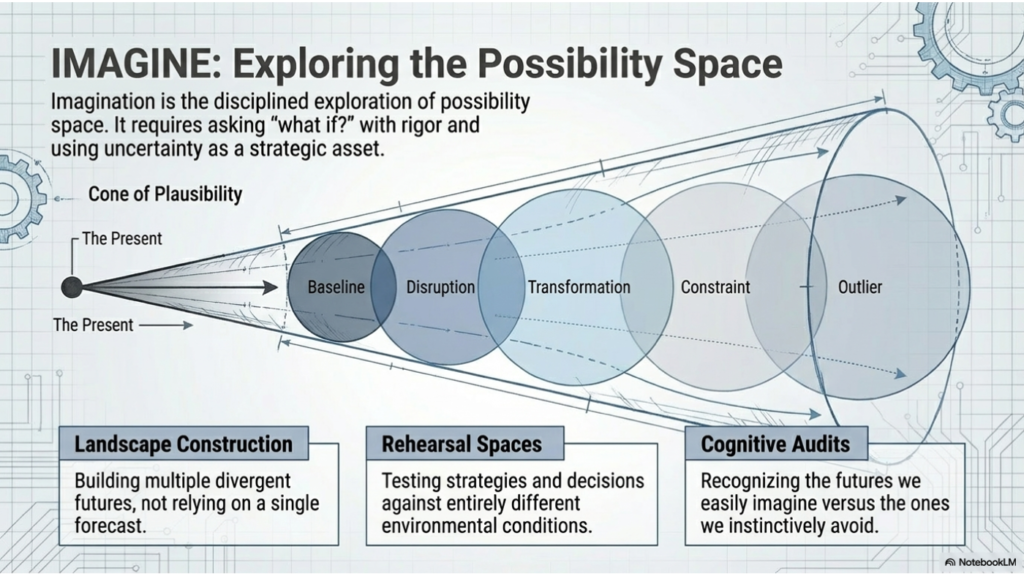
The second capacity is imagination: the ability to construct vivid, plausible pictures of futures that do not yet exist — and to use them as thinking tools. This is not daydreaming. It is disciplined exploration of possibility space: asking what if? with rigor, building scenarios that stretch assumptions and reveal hidden vulnerabilities and opportunities.
What this looks like in practice:
- Constructing multiple futures — not one forecast, but a landscape of divergent possibilities
- Using scenarios as rehearsal spaces: testing strategies, decisions, and values against different conditions
- Recognizing one’s own cognitive defaults — the futures we find easy to imagine and those we instinctively avoid
- Making the future feelable: translating abstract possibilities into narratives and experiences that teams and organizations can engage with
The leadership competency: Strategic imagination. The capacity to hold multiple, contradictory futures in mind without rushing to resolve them. Using uncertainty as raw material for creative strategy, not as a threat to be eliminated.
III. CREATE — The Leader Who Designs Reality
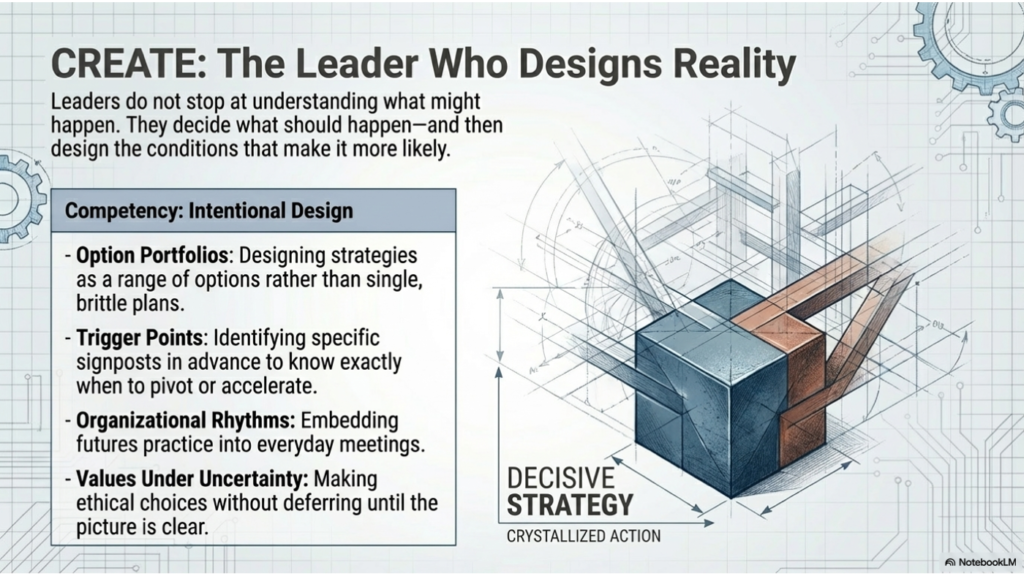
The third capacity is agency: the ability to move from insight and imagination to deliberate action. A futures-literate leader does not stop at understanding what might happen. They decide what should happen — and then design the conditions that make it more likely. This is futures design: the intentional shaping of systems, strategies, organizations, and cultures toward preferred futures.
What this looks like in practice:
- Designing strategies as portfolios of options, not single plans
- Identifying signposts and trigger points — knowing in advance when to pivot, pause, or accelerate
- Embedding futures practice into organizational rhythms: meetings, reviews, rituals that keep the long view alive
- Making values-driven choices under uncertainty — not deferring ethics until the picture is clear
The leadership competency: Intentional design. The capacity to act with conviction in ambiguous conditions. Treating the future not as something that arrives, but as something that is continuously co-created through present decisions.
Futures Literacy as a Leadership Foundation
The triad of See — Imagine — Create is grounded in futures literacy: the competence to understand and use the future in the present. Developed as a concept by UNESCO, futures literacy is increasingly recognized as a fundamental capability for navigating complexity.
For leaders, futures literacy translates into a distinctive set of competencies:
- Comfort with not knowing. The ability to operate effectively when outcomes are uncertain, without defaulting to false confidence or paralysis.
- Assumption awareness. Recognizing the hidden beliefs and mental models that shape strategy — and being willing to challenge them.
- Temporal agility. Moving fluidly between short-term pressures and long-term implications. Keeping the 10-year horizon alive in a quarterly world.
- Narrative intelligence. Understanding that futures are shaped by the stories organizations tell themselves. The ability to read, rewrite, and deploy strategic narratives.
- Ethical foresight. Asking not only what could happen but who benefits, who bears the cost, and what does our strategy quietly normalize?
How Futures Leadership Works
We do not deliver foresight reports for leaders to read. We build the capacity for leaders to think, decide, and act with the future as their working material. The process moves through four interconnected layers:
1. Horizon Reading
We begin by sharpening perception. Through structured scanning, expert conversations, and cross-domain analysis, we help leaders see the landscape of emerging change relevant to their context — not as a data dump, but as a curated field of attention.
2. Assumption Mapping
Every strategy rests on beliefs about how the world works. We surface those beliefs, test them against evidence and alternative logics, and identify the ones most likely to be disrupted. This is where leaders often discover their most consequential blind spots.
3. Scenario Exploration
We construct multiple futures — not as predictions, but as spaces for rehearsal. Leaders enter these scenarios to stress-test decisions, discover hidden vulnerabilities, and practice judgment in conditions they have not yet encountered. The goal is not to choose the “right” future, but to build the capacity to respond to any of them.
4. Futures Design
We move from exploration to creation: designing strategic options, signpost systems, and organizational practices that embed futures thinking into the way the organization leads, decides, and adapts. This is where imagination becomes operational.
Futures Coaching
Futures Coaching is the element that turns insight into leadership behavior. While workshops generate clarity, coaching is where leaders metabolize that clarity: confronting default patterns under uncertainty, refining judgment, and building new decision habits.
Delivered as a confidential series of sessions (typically 4–10), Futures Coaching works at the intersection of personal leadership development and futures practice:
- Decision architecture: knowing where to commit and where to keep options open. Designing reversible decisions and timing strategic moves.
- Narrative discipline: detecting the stories that trap you — inside the organization and inside yourself — and rewriting them into usable strategic frames.
- Values under pressure: articulating what is non-negotiable and building strategies that do not quietly betray those commitments when trade-offs appear.
- Presence in ambiguity: holding multiple futures without losing authority, momentum, or coherence.
- Personal signposts: what to watch in yourself and your environment to know when to pivot, pause, or accelerate.
What You Receive
Depending on scope and engagement format, the work produces:
- Horizon Brief: a curated map of the most relevant, non-obvious signals of change in your context
- Leadership Scenarios: a set of futures designed specifically for decision use — not for presentation, but for practice
- Strategic Options Portfolio: a range of moves — from “no-regret” actions to asymmetric bets — calibrated to different futures
- Signposts & Triggers: what to monitor, when to act, what to stop doing
- Futures Operating Rhythm: meeting formats, cadence, and practices that keep futures thinking embedded in leadership, not confined to an annual retreat
- Coaching Pathway: session structure and continuity plan for ongoing leadership development
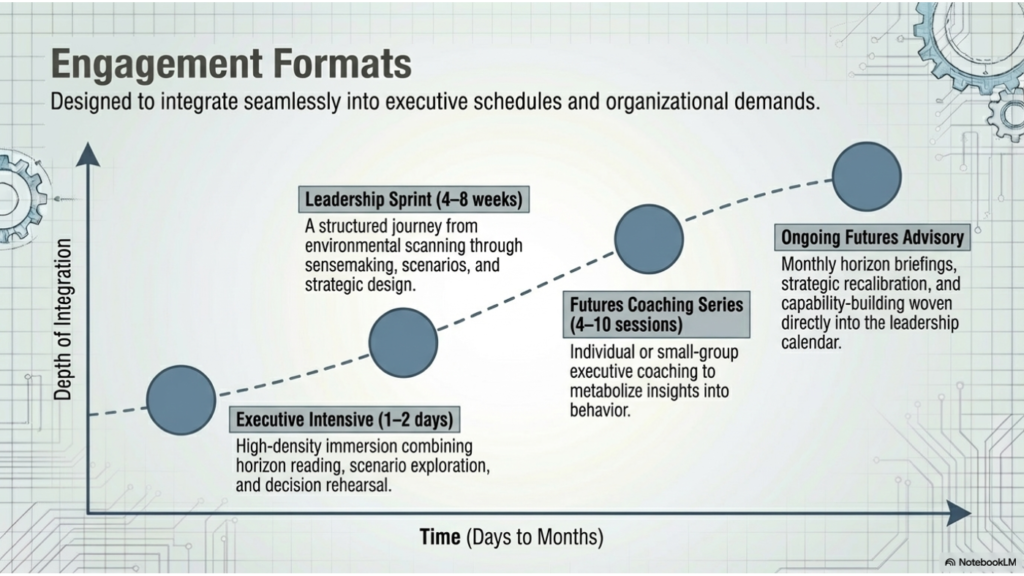
Engagement Formats
- Executive Intensive (1–2 days): high-density immersion combining horizon reading, scenario exploration, and decision rehearsal
- Leadership Sprint (4–8 weeks): a structured journey from scanning through sensemaking, scenarios, and strategic design
- Ongoing Futures Advisory: monthly horizon briefings, strategic recalibration, and capability-building woven into the leadership calendar
- Futures Coaching Series (4–10 sessions): individual or small-group, running alongside any of the above
Futures Leadership is for leaders who understand that the future is not a place they are heading toward — it is a material they are working with, every day. It is for those who want to see what others miss, imagine what others cannot, and create what others think is too early to begin.
The future is not a forecast. It is a practice. Lead with it.